

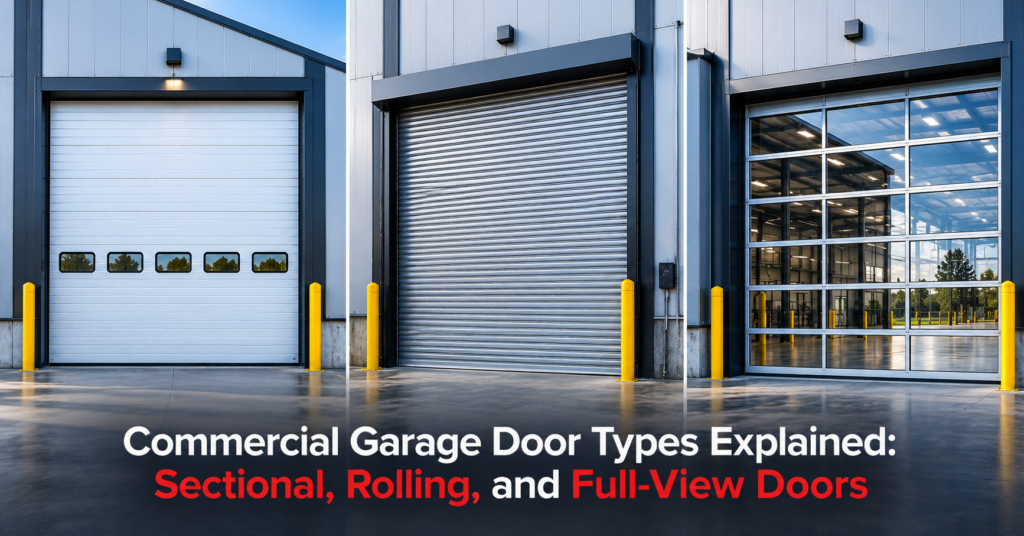
Not every commercial garage door is built the same way, and the differences go far beyond appearance. Sectional, rolling, and full-view doors each use a completely different mechanism, which means each one performs differently depending on the space, industry, and daily demands placed on it.
At VP Commercial Garage Doors, one of the most common questions we hear is simply, “What’s actually the difference?” This guide breaks down how each of these three commercial garage door types works, where each one excels, and how to think about which fits a given facility best.
How These Three Door Types Actually Differ
The core difference comes down to mechanism and movement. Sectional doors are made of horizontal panels hinged together, traveling up and along a track system before settling flat against the ceiling. Rolling doors use a curtain of interlocking slats that coils around a drum mounted above the opening. Full-view doors are typically built with an aluminum frame and glass panels, prioritizing visibility over the heavier security of the other two types. Each mechanism creates a different set of strengths and trade-offs.
Sectional Garage Doors
How They’re Built
Sectional doors are constructed from horizontal panel sections connected by hinges, which allow the door to bend as it travels along vertical and horizontal tracks before resting flat under the ceiling when open.
Strengths
This design supports a wide range of customization, including added insulation, windows, or even full-view glass panel sections. Sectional doors also tend to run quieter than rolling doors and offer strong insulation performance, which matters in climates with real seasonal extremes.
Limitations
The hinge-and-roller system is mechanically more complex than a rolling door’s simpler curtain design, which means more components that can eventually wear. Sectional doors also require enough overhead track clearance and side-room space, which can be a limiting factor in facilities with tight ceiling space.
Best Suited For
Warehouses, distribution centers, and facilities that want strong insulation and design flexibility, including options for added visibility through window sections.
Rolling Steel Garage Doors
How They’re Built
Rolling, or coiling, doors use a curtain of interlocking steel slats that rolls up into a drum mounted above the opening, rather than traveling along an overhead track system.
Strengths
Because the curtain coils compactly above the opening, rolling doors don’t require the same overhead track space sectional doors do, making them a strong fit for facilities with limited ceiling clearance. Their simpler mechanical design also tends to result in a longer service life, and rolling doors generally offer stronger security and are the only one of these three types available with fire-rated construction.
Limitations
Rolling doors typically don’t insulate as effectively as sectional doors and tend to operate louder due to their metal slat construction. They also offer fewer customization options in terms of appearance.
Best Suited For
Retail loading bays, self-storage facilities, and any environment where security and durability matter more than appearance or insulation performance.
Full-View Garage Doors
How They’re Built
Full-view doors use an aluminum frame fitted with glass panels, often tempered for durability, allowing natural light and visibility through the door itself.
Strengths
These doors bring visibility and natural light into a space in a way that sectional or rolling doors simply can’t, making them a strong aesthetic choice for businesses where appearance and openness matter.
Limitations
Full-view doors generally offer less security and insulation performance compared to solid sectional or rolling doors, which makes them a poor fit for facilities prioritizing those factors.
Best Suited For
Showrooms, restaurants, breweries, and retail spaces where visibility and design are priorities alongside basic functionality.
Side-by-Side Comparison
| Factor | Sectional | Rolling Steel | Full-View |
|---|---|---|---|
| Space required | Needs overhead track clearance | Compact, minimal ceiling space | Similar to sectional |
| Insulation | Strong | Limited | Minimal |
| Security | Good | Excellent | Basic |
| Noise level | Quieter | Louder | Moderate |
| Fire-rated options | Limited | Available | Not typically available |
| Customization | High | Lower | Aesthetic-focused |
| Best fit | Warehouses, distribution centers | Retail, self-storage, security-focused facilities | Showrooms, restaurants, retail storefronts |
Matching Door Type to Industry
Different industries consistently lean toward different door types based on their specific priorities. Auto dealerships often use full-view doors at showroom entrances paired with sectional doors at service bays. Fire stations typically rely on high-cycle sectional or rolling doors built for rapid, reliable operation. Retail businesses frequently choose rolling steel for loading bays and storefront security. Cold storage facilities generally favor insulated sectional doors to maintain temperature control. Restaurants and breweries often choose full-view doors to create an open, inviting storefront. Matching door type to industry norms is a useful starting point, though every facility’s specific layout and priorities still matter.
Understanding Cycle Ratings
Commercial doors are often rated by cycle count, with one cycle representing a single complete open-and-close sequence. Standard-duty doors are typically built for a baseline cycle rating suited to moderate daily use, while higher-cycle options exist for facilities with much more frequent operation. Understanding your facility’s actual daily cycle frequency, covered in more depth in our guide on high-traffic warehouse door maintenance, helps determine which door type and cycle rating actually fits your operation.
Common Mistakes When Comparing Door Types
Choosing based on appearance alone. A full-view door might look appealing, but it isn’t the right fit for a facility that needs strong security or insulation.
Assuming all sectional doors are the same. Sectional doors range widely in insulation level and customization, so it’s worth confirming the specific configuration matches your needs.
Overlooking space constraints. Sectional doors need overhead track clearance that rolling doors don’t require, which can eliminate an option before it’s even seriously considered.
Ignoring fire rating requirements. Facilities with specific fire code needs should confirm which door types actually offer compliant options before deciding.
Why Working With a Commercial Specialist Matters
Understanding the mechanical differences between these door types is only part of the decision — matching that understanding to your facility’s actual layout and daily operations is where it counts. VP Commercial Garage Doors helps businesses walk through this comparison in the context of their specific space, building on the broader framework covered in our guide on how to choose the right commercial garage door for your business.
Where We Help Businesses Choose the Right Door Type
We work with facilities throughout the Chicagoland area, including Aurora, Wheaton, Northbrook, and Palatine, along with many surrounding communities. Wherever your business is located, our team can help you compare sectional, rolling, and full-view options to find the right fit.
FAQs About Commercial Garage Door Types
Which commercial door type lasts the longest?
Rolling steel doors generally offer a longer service life due to their simpler mechanical design, though sectional doors can also perform well with consistent maintenance.
Can a full-view door be used for a loading dock?
It’s not typically recommended, since full-view doors offer less security and insulation than sectional or rolling doors, which are better suited to loading dock demands.
Do rolling doors really offer better security than sectional doors?
Generally, yes. Their solid slat construction and simpler mechanism tend to provide stronger resistance against forced entry compared to a sectional door.
Is insulation only available on sectional doors?
Insulation options are strongest on sectional doors, though some rolling door configurations offer limited insulation as well.
How do I know which cycle rating my facility actually needs?
It depends on how frequently the door will open and close each day. A professional can help assess your usage pattern and recommend the appropriate cycle rating.
Contact VP Commercial Garage Doors
If your business needs dependable Commercial Garage Door Repair, Commercial Overhead Door Installation, Commercial Garage Door Maintenance, Rolling Steel Door Repair, High-Speed Commercial Doors, Dock Leveler Repair, Loading Dock Equipment Service, or Emergency Commercial Garage Door Repair, trust the experienced team at VP Commercial Garage Doors.
We proudly serve businesses throughout Elk Grove Village, Schaumburg, Naperville, Aurora, Buffalo Grove, Addison, Franklin Park, Palatine, Wheeling, Oak Brook, and surrounding Illinois communities.
Phone: 847 380 6448
Website: VP Commercial Garage Doors
Call VP Commercial Garage Doors today to schedule professional commercial garage door service and keep your warehouse or industrial facility operating safely, efficiently, and without costly interruptions.
Final Thoughts
Sectional, rolling, and full-view doors each solve a different problem. Sectional doors bring insulation and customization, rolling doors bring compact durability and security, and full-view doors bring visibility and design. Understanding these mechanical differences — rather than choosing based on appearance or assumption — leads to a door that actually performs the way your facility needs it to.
If you’re still weighing which type fits your space, working through the comparison with a specialist is the most reliable way to land on the right choice.
Summary
Commercial garage door types differ mainly by mechanism: sectional doors use hinged panels on an overhead track offering strong insulation and customization, rolling steel doors coil into a compact drum offering superior security and durability, and full-view doors use glass panels for visibility. Each type suits different industries and space requirements.