

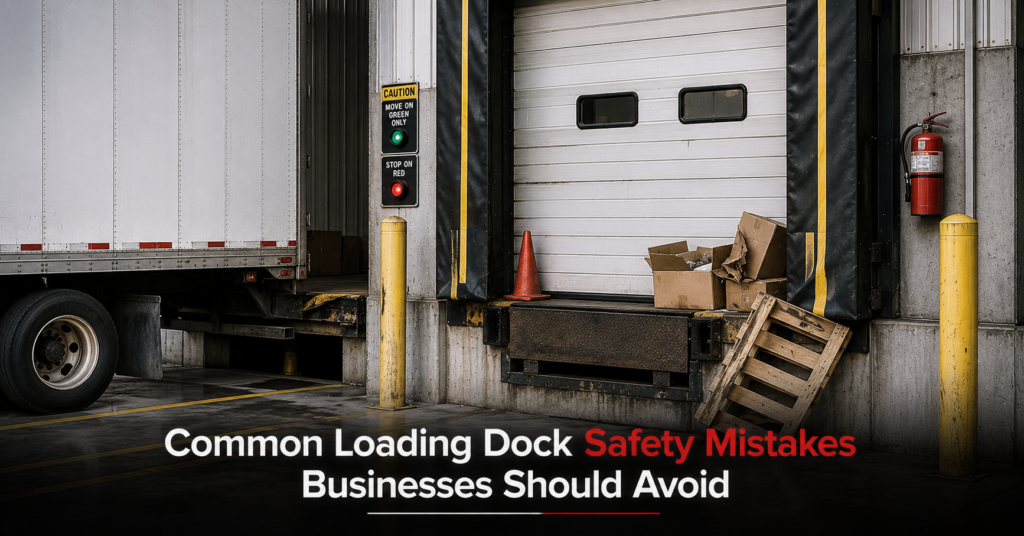
The loading dock is one of the busiest, most mechanically complex parts of any facility — and it’s also one of the most hazardous. Trucks, forklifts, pedestrians, and heavy equipment all share the same tight space, often at the same time. Small oversights that would be minor elsewhere can turn into serious incidents here.
At VP Commercial Garage Doors, we’ve seen how a handful of recurring mistakes show up again and again across different facilities, regardless of size or industry. This guide covers the most common loading dock safety mistakes businesses make, and what to do instead to keep both people and operations protected.
Why Loading Docks Carry Higher Safety Risk
Loading docks account for a disproportionate share of workplace incidents compared to other areas of a facility, largely because of how much activity happens in such a concentrated space. Industry safety data consistently shows that for every recorded injury at a loading dock, there are hundreds of near-misses that never get reported — a strong signal that many facilities are operating closer to the edge of a real accident than they realize.
Mistake #1: Not Using Vehicle Restraints Consistently
Trailer creep — when a trailer gradually shifts or rolls away from the dock during loading — is one of the leading causes of serious and fatal loading dock accidents. This happens when restraints aren’t used consistently, or when a dock leveler engages before the restraint is properly locked in place.
Prevention: Make restraint use a non-negotiable step in every loading sequence, and confirm the leveler is designed not to engage until the restraint is locked, removing the chance of human error skipping the step.
Mistake #2: Overlooking Dock Leveler Safety Mechanisms
Dock levelers involve genuine mechanical hazards — pinch points, shearing risks, and moving parts that can cause serious injury if used incorrectly or left poorly maintained. These built-in safety mechanisms exist for a reason, but they’re often overlooked in the rush of daily operations.
Prevention: Make sure staff understand exactly how the leveler’s safety features work, and include leveler-specific checks as part of routine loading dock equipment maintenance rather than treating it as a background fixture.
Mistake #3: Inadequate Lighting
Poor lighting is a quiet but serious hazard. Recognized safety guidelines call for a meaningful minimum lighting level in active dock areas, yet many facilities operate well below it. Reduced visibility makes it harder for forklift operators to spot dock edges, pedestrians, and obstacles, and incident rates tend to climb during early morning or late shifts when natural light is limited.
Prevention: Upgrade to consistent, well-positioned lighting that covers the dock approach, the pit area, and the trailer interior, not just the general work area.
Mistake #4: Poor Communication Between Drivers and Staff
Miscommunication between truck drivers, forklift operators, and dock staff is behind a significant share of avoidable incidents. Relying on shouting or informal hand signals leaves too much room for error, especially in a noisy, fast-moving environment.
Prevention: Standardized visual signaling — like red and green light systems — removes ambiguity about when it’s safe to approach, load, or depart, and keeps everyone working from the same clear signal.
Mistake #5: Ignoring Slip, Trip, and Fall Hazards
Wet or slippery surfaces, uneven flooring, and debris left in walkways are among the most common causes of loading dock injuries. Weather makes this worse, with rain, snow, and leaves creating conditions that build up quickly if not addressed.
Prevention: Regular sweeping, prompt cleanup of spills, and consistent debris removal go a long way, especially heading into wetter or snowier seasons.
Mistake #6: Skipping Fall Protection at the Dock Edge
Falls from the dock edge remain one of the most frequently cited safety violations across industries, and loading docks are no exception. A worker stepping backward without realizing how close they are to the edge is a genuinely common scenario.
Prevention: Guardrails, dock safety gates, and clearly marked edges — often with high-visibility striping — significantly reduce this risk without slowing down daily operations.
Mistake #7: Inconsistent or Undocumented Maintenance
A maintenance routine that happens irregularly, or isn’t documented at all, makes it difficult to catch developing issues before they become safety incidents. This applies to dock levelers, restraints, doors, and lighting alike.
Prevention: A documented schedule — daily visual checks, more thorough functional tests on a regular basis, and periodic professional inspection — creates accountability and makes it far easier to spot patterns over time.
Mistake #8: One-Time Training With No Refreshers
Safety training that happens once, during onboarding, and never again tends to fade quickly. Staff turnover, procedural changes, and simple forgetfulness all erode the effectiveness of a single training session over time.
Prevention: Regular refresher training, even brief sessions, keeps safety procedures front of mind and helps new staff absorb the same standards as more experienced team members.
Mistake #9: Poor Visibility and Signage
Unclear boundaries between vehicle zones, pedestrian paths, and the dock edge itself contribute to collisions and near-misses. This is especially risky in facilities where attention is often split between multiple simultaneous tasks.
Prevention: High-visibility markings, clear signage, and well-defined pedestrian paths make hazards obvious at a glance, rather than relying on everyone remembering where the danger zones are.
Building a Safer Loading Dock: A Quick Checklist
- Require vehicle restraint use on every single load, without exception
- Confirm dock leveler safety mechanisms are functioning and understood by staff
- Upgrade lighting to meet recommended levels across the entire dock area
- Implement a standardized visual communication system for drivers and staff
- Keep walkways and staging areas clear of debris and moisture
- Install guardrails or safety gates at exposed dock edges
- Maintain a documented, consistent maintenance schedule
- Schedule regular safety refresher training, not just onboarding sessions
- Use high-visibility markings to clearly define hazard zones
Why Working With a Commercial Specialist Matters
Avoiding these mistakes starts with treating the loading dock as the high-risk environment it actually is, rather than just another part of daily operations. VP Commercial Garage Doors helps facilities evaluate their dock equipment and maintenance routines as part of keeping your loading dock running efficiently year-round, so safety gaps get identified and addressed before they lead to an incident.
Where We Help Businesses Improve Loading Dock Safety
We work with facilities throughout the Chicagoland area, including Naperville, Schaumburg, Aurora, and Elgin, along with many surrounding communities. Wherever your facility is located, our team can help you identify safety gaps in your current dock setup and build a plan to close them.
FAQs About Loading Dock Safety Mistakes
What’s the leading cause of serious loading dock accidents?
Trailer creep — a trailer shifting or rolling away from the dock without proper restraint — is one of the leading causes of serious and fatal loading dock incidents.
How much does lighting really affect loading dock safety?
Significantly. Poor lighting makes it harder to spot hazards and contributes to higher incident rates, especially during early morning or evening shifts with limited natural light.
Is verbal communication enough between drivers and dock staff?
Not reliably. Standardized visual signals, like light systems, reduce the miscommunication that leads to premature departures and other avoidable incidents.
How often should loading dock safety training happen?
Regularly, not just during onboarding. Refresher sessions help maintain awareness and keep procedures consistent as staff and conditions change over time.
Do minor slip and fall hazards really matter compared to bigger mechanical risks?
Yes. Slips, trips, and falls are among the most common causes of loading dock injuries, and they’re often easier to prevent than mechanical hazards with basic housekeeping and maintenance.
Contact VP Commercial Garage Doors
If your business needs dependable Commercial Garage Door Repair, Commercial Overhead Door Installation, Commercial Garage Door Maintenance, Rolling Steel Door Repair, High-Speed Commercial Doors, Dock Leveler Repair, Loading Dock Equipment Service, or Emergency Commercial Garage Door Repair, trust the experienced team at VP Commercial Garage Doors.
We proudly serve businesses throughout Elk Grove Village, Schaumburg, Naperville, Aurora, Buffalo Grove, Addison, Franklin Park, Palatine, Wheeling, Oak Brook, and surrounding Illinois communities.
Phone: 847 380 6448
Website: VP Commercial Garage Doors
Call VP Commercial Garage Doors today to schedule professional commercial garage door service and keep your warehouse or industrial facility operating safely, efficiently, and without costly interruptions.
Final Thoughts
Loading dock safety mistakes tend to repeat across facilities because they’re often treated as minor inconveniences rather than genuine risks. Restraint use, proper lighting, clear communication, and consistent maintenance aren’t optional extras — they’re what separates a dock that runs safely from one that’s operating closer to an incident than anyone realizes.
If any of these mistakes sound familiar at your facility, it’s worth addressing them before they turn into something more serious.
Summary
Common loading dock safety mistakes include inconsistent vehicle restraint use, overlooked dock leveler safety mechanisms, inadequate lighting, poor communication between drivers and staff, slip and fall hazards, missing fall protection, and inconsistent maintenance. Addressing these mistakes reduces the risk of serious accidents and near-misses at the loading dock.