

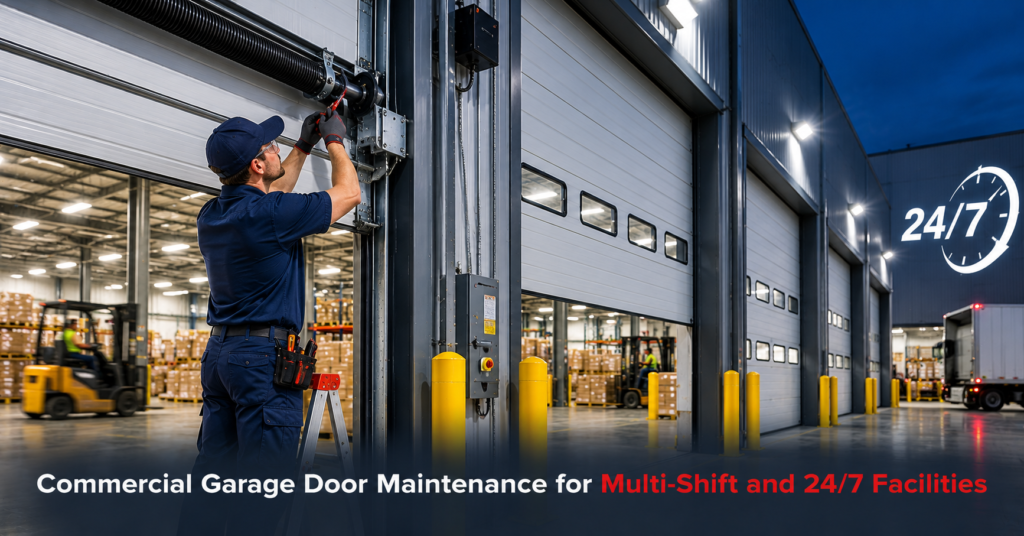
A door that opens and closes around the clock doesn’t get a break — and neither does its hardware. Facilities running multiple shifts or 24/7 operations put far more wear on a commercial garage door than a standard nine-to-five building ever will. At VP Commercial Garage Doors, we see this firsthand with distribution centers, manufacturing plants, and logistics hubs where downtime simply isn’t an option. This guide covers what commercial garage door maintenance should look like for facilities that never really stop running.
Why 24/7 Facilities Need a Different Maintenance Approach
A door cycling a handful of times a day wears very differently than one cycling hundreds of times across three shifts. More cycles mean more stress on springs, cables, rollers, and the opener — and that stress adds up faster than most facility managers expect.
For round-the-clock operations, maintenance isn’t just about keeping the door working. It’s about preventing a breakdown that could halt shipping, receiving, or production during an active shift, when there’s no slow period to absorb the disruption.
How Multi-Shift Use Affects Door Components
Springs Wear Out Faster
Springs are rated for a certain number of cycles, and high-use doors reach that limit much sooner than standard doors. A facility running three shifts can put a door through years’ worth of residential-level use in a matter of months. Watching for early signs of fatigue helps avoid an unexpected garage door spring repair mid-shift.
Openers Run Harder
Commercial openers in 24/7 settings rarely get downtime to cool off between cycles. Motors, chains, and belts experience more friction and heat, which can shorten their lifespan if not properly maintained.
Tracks and Rollers Take More Impact
Constant movement means more opportunities for rollers to wear flat, hinges to loosen, and tracks to shift out of alignment. In high-traffic dock areas, this wear is often compounded by vehicle activity nearby.
Seals Degrade Quicker
Doors that stay in near-constant motion compress and release their seals far more often. Bottom and side seals can flatten or crack sooner than they would on a lower-use door, letting in dust, drafts, and moisture.
Building a Maintenance Schedule for High-Use Facilities
Daily Checks
Staff on each shift can do quick visual and sound checks:
- Listen for grinding, squealing, or banging during operation
- Watch for the door moving unevenly or hesitating
- Note any gaps, visible damage, or debris blocking the track
- Confirm safety sensors are responding properly
Weekly or Monthly Checks
A more detailed look should happen on a regular cycle:
- Inspect rollers, hinges, and hardware for looseness or wear
- Check cables and drums for fraying or slack
- Test the door balance and opener force settings
- Clean and lubricate moving parts with the right products
Scheduled Professional Inspections
Beyond day-to-day checks, a full commercial garage door inspection by a trained technician should happen more frequently than it would for a standard-use facility. High-cycle doors benefit from closer, more regular professional attention rather than waiting for an annual visit.
Common Problems in 24/7 and Multi-Shift Facilities
- Premature spring failure from exceeding cycle ratings faster than expected
- Opener overheating or strain from near-continuous use without rest periods
- Worn rollers and bent tracks from heavy, repeated cycling
- Seal breakdown leading to drafts, dust, and temperature control issues
- Delayed repairs because finding a maintenance window between shifts is harder
Common Mistakes High-Use Facilities Make
- Using a standard maintenance schedule. A door cycling constantly needs more frequent checks than typical maintenance guidelines suggest.
- Waiting for a slow period that never comes. In a true 24/7 operation, maintenance has to be scheduled deliberately, not left for “whenever things calm down.”
- Overlooking opener duty cycle ratings. Not every opener is built for continuous heavy use — mismatched equipment wears out faster.
- Skipping shift-to-shift communication. Issues noticed on one shift don’t always get passed along to the next, delaying needed repairs.
- Treating all doors the same. High-traffic dock doors need more attention than a backup door used only occasionally.
Expert Tips for Keeping High-Use Doors Running Smoothly
- Choose heavy-duty springs and commercial-grade openers rated for high-cycle use from the start
- Set up a preventive maintenance plan with a schedule that matches actual usage, not just the calendar
- Create a simple shift-log system so staff can report door issues immediately
- Stock common wear parts, like rollers and seals, so minor swaps don’t require waiting
- Schedule major maintenance or garage door opener repair during the lowest-traffic shift to minimize disruption
- Keep a maintenance history for each door so patterns in wear become easier to spot over time
Why Professional Support Matters for 24/7 Operations
High-cycle doors need a maintenance partner who understands the difference between standard wear and the accelerated wear that comes with multi-shift use. VP Commercial Garage Doors supports facilities in Glenview, Niles, Mount Prospect, and Rolling Meadows with maintenance scheduling built around how often their doors actually run — not a one-size-fits-all checklist. For facilities with aging equipment, this often includes a conversation about commercial garage door installation options better suited to continuous use.
FAQs
How often should a 24/7 facility have its garage doors inspected?
More often than a standard-use facility — the right frequency depends on daily cycle counts, but high-traffic doors benefit from more frequent professional checks throughout the year.
Can a standard commercial door handle 24/7 use?
It depends on the door and opener’s duty cycle rating. Equipment designed for continuous use holds up better than standard components under constant cycling.
What’s the biggest risk of skipping maintenance in a multi-shift facility?
Unexpected downtime during an active shift, which can disrupt shipping, receiving, or production with no slow period to absorb the delay.
Should maintenance be scheduled during a specific shift?
Many facilities schedule it during their lowest-traffic shift to reduce disruption, though this depends on each facility’s operating pattern.
Do high-cycle doors need different parts than standard doors?
Often, yes. Heavy-duty springs, commercial-grade openers, and wear-resistant rollers are typically better suited to continuous, high-frequency use.
Contact VP Commercial Garage Doors
If your business needs dependable Commercial Garage Door Repair, Commercial Overhead Door Installation, Commercial Garage Door Maintenance, Rolling Steel Door Repair, High-Speed Commercial Doors, Dock Leveler Repair, Loading Dock Equipment Service, or Emergency Commercial Garage Door Repair, trust the experienced team at VP Commercial Garage Doors.
We proudly serve businesses throughout Elk Grove Village, Schaumburg, Naperville, Aurora, Buffalo Grove, Addison, Franklin Park, Palatine, Wheeling, Oak Brook, and surrounding Illinois communities.
Phone: 847 380 6448
Website: VP Commercial Garage Doors
Call VP Commercial Garage Doors today to schedule professional commercial garage door service and keep your warehouse or industrial facility operating safely, efficiently, and without costly interruptions.
Conclusion
Facilities that never stop running need maintenance that keeps pace with that demand. Multi-shift and 24/7 operations put extra stress on springs, openers, tracks, and seals, which means standard maintenance schedules often fall short. Daily visual checks, more frequent professional inspections, and a maintenance plan matched to actual usage all help prevent the kind of breakdown that can bring a busy facility to a stop. Investing in the right upkeep now keeps doors reliable through every shift, every day of the year.
Summary
Multi-shift and 24/7 facilities put extra wear on commercial garage doors, wearing out springs, openers, rollers, and seals faster than standard-use buildings. Daily visual checks, frequent professional inspections, and a usage-based maintenance schedule help prevent unexpected downtime and keep high-cycle doors running reliably.