

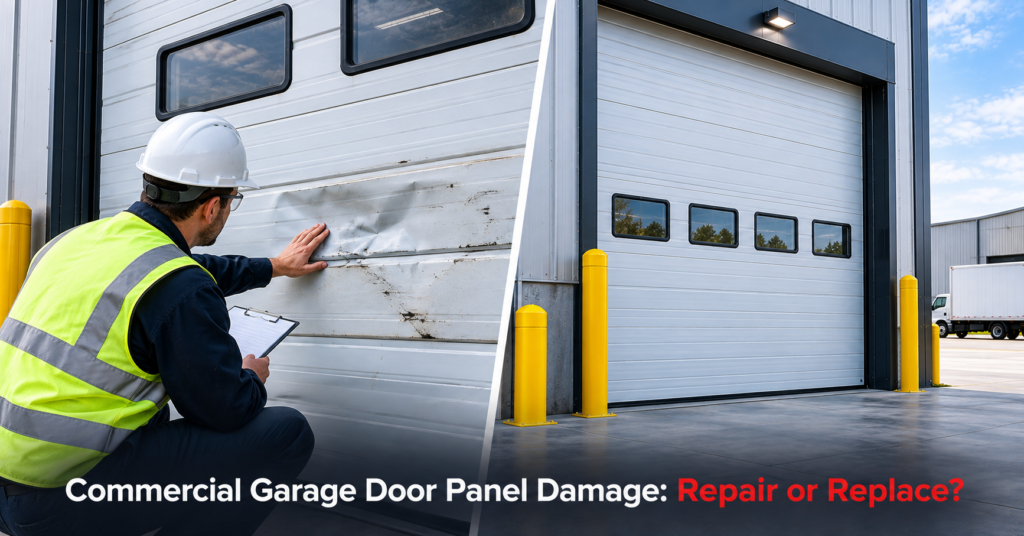
A dented, cracked, or warped panel can turn a reliable commercial garage door into a daily headache. Business owners across the Chicago suburbs often face the same question: is garage door panel repair enough, or does the whole door need replacing? At VP Commercial Garage Doors, we get this question regularly, and the right call depends on how bad the damage is, how old the door is, and how much it’s affecting daily operations. This guide breaks down the decision so you can move forward with confidence.
Why Commercial Garage Door Panels Get Damaged
Commercial doors take a beating simply because they’re used so often. A few common causes stand out.
Vehicle and equipment impact is the biggest one. Forklifts, delivery trucks, and pallet jacks brushing against a panel are a leading cause of dents and cracks in warehouse and loading dock settings.
Weather plays a role too. High winds, hail, and repeated freeze-thaw cycles can warp thin steel or aluminum panels over time, especially on doors facing open lots.
Age and material fatigue matter as well. Panels that have been opening and closing dozens of times a day for years naturally weaken at the seams and hinges.
Finally, rust and corrosion from moisture exposure — especially near loading docks or coastal-adjacent weather patterns — can eat away at panel edges long before the rest of the door shows wear.
Signs a Panel Needs Attention
Not every mark on a panel is urgent, but a few signs mean it’s time to call in a technician:
- Visible dents, cracks, or bowing in the panel surface
- Gaps between panel sections that weren’t there before
- Rust spots or peeling paint exposing bare metal
- The door binding, hesitating, or making grinding noises during operation
- A panel that no longer sits flush against its neighbors
Catching these early is one of the simplest ways to avoid a bigger repair bill down the road.
Panel Repair vs. Panel Replacement: How to Decide
This is the core question, and the answer usually comes down to scope and severity.
When Repair Makes Sense
Repair is typically the right move when:
- Only one panel is affected, and the dent or crack is minor
- The door’s track, rollers, and hinges are still properly aligned
- A matching replacement panel is available for that specific door model
- The rest of the door and opener are functioning normally
In these cases, a straightforward commercial garage door repair visit can often resolve the issue without disrupting the whole system.
When Replacement Is the Better Choice
Replacement becomes the smarter path when:
- Multiple panels show damage, or the door is older with deteriorating insulation
- Structural warping is affecting how smoothly the door opens and closes
- The original panel style has been discontinued, and no match exists
- The same section keeps failing and needs repeat service calls
When a door reaches this point, a full commercial garage door installation often makes more sense than patching one issue at a time.
The Risks of Ignoring Panel Damage
Putting off a decision doesn’t make the problem go away — it usually makes it worse.
A damaged panel can create a safety hazard for employees, forklift operators, and anyone entering or exiting the building through that door. Misalignment from a warped panel also puts extra strain on the opener and track system, which can lead to a bigger, more disruptive breakdown.
There’s an energy angle too. Gaps around a damaged panel let conditioned air escape, which affects comfort and efficiency inside the building. And a visibly dented or rusted door isn’t exactly the impression most businesses want to give customers, vendors, or visitors pulling up to the property.
Common Mistakes Businesses Make
A few missteps show up again and again:
- Assuming a dent is purely cosmetic. Even small dents can throw off panel alignment and strain the opener over time.
- Attempting a DIY panel swap. Panels vary by gauge, insulation type, and manufacturer — a mismatched panel can cause more problems than it solves.
- Waiting until the door stops working entirely. Small issues are far easier to address than a door that’s completely off track.
- Skipping a full inspection. Fixing the visible dent without checking the track, springs, and opener can leave a related issue undiscovered.
- Ignoring opener settings after a repair. A newly repaired panel can change the door’s weight balance, which sometimes requires an opener adjustment.
Expert Tips for Longer Panel Life
A little proactive care goes a long way for commercial doors that see heavy daily use:
- Schedule a preventive maintenance plan check on a regular basis, not just when something breaks
- Install protective bollards or guardrails near loading dock doors to reduce vehicle contact
- Train staff and drivers on safe clearance distances around door panels
- Address minor dents right away instead of letting them sit
- Keep a record of your door’s model and panel specs on file, which speeds up sourcing a match if replacement is ever needed
Why a Professional Assessment Matters
It’s not always obvious from a quick look whether damage is cosmetic or structural. A trained technician can check panel alignment, spring tension, and track condition together, rather than just patching the part that’s visibly dented.
VP Commercial Garage Doors works with businesses in Naperville, Aurora, Schaumburg, Arlington Heights, and surrounding communities to evaluate panel damage on-site and recommend the option that actually fits the door’s condition — not just the fastest fix. That assessment often includes a look at the garage door opener repair needs as well, since panel damage and opener strain frequently go hand in hand.
FAQs
Can a single damaged panel be replaced without replacing the whole door?
Often, yes. Many sectional commercial doors allow one panel to be swapped out, as long as a matching panel is still available for that door line.
How long does a commercial garage door panel repair usually take?
A straightforward panel swap can often be completed in a single visit, though the timeline depends on panel availability and the extent of the damage.
Does a dented panel really affect how the door operates?
Yes. Even a small dent can shift panel alignment, cause the door to bind on the track, or add strain to the opener over time.
What’s the difference between insulated and non-insulated panels?
Insulated panels have a foam core that helps regulate temperature and reduce noise, while non-insulated panels are typically lighter and simpler in construction. The right choice depends on how the space behind the door is used.
How do I know if my door needs full replacement instead of a panel swap?
If several panels are damaged, the frame is warping, or the panel style is discontinued, replacement is usually the more reliable long-term solution.
Contact VP Commercial Garage Doors
If your business needs dependable Commercial Garage Door Repair, Commercial Overhead Door Installation, Commercial Garage Door Maintenance, Rolling Steel Door Repair, High-Speed Commercial Doors, Dock Leveler Repair, Loading Dock Equipment Service, or Emergency Commercial Garage Door Repair, trust the experienced team at VP Commercial Garage Doors.
We proudly serve businesses throughout Elk Grove Village, Schaumburg, Naperville, Aurora, Buffalo Grove, Addison, Franklin Park, Palatine, Wheeling, Oak Brook, and surrounding Illinois communities.
Phone: 847 380 6448
Website: VP Commercial Garage Doors
Call VP Commercial Garage Doors today to schedule professional commercial garage door service and keep your warehouse or industrial facility operating safely, efficiently, and without costly interruptions.
Conclusion
Panel damage doesn’t automatically mean a full door replacement — but it doesn’t mean every dent should be ignored, either. The right decision depends on how many panels are affected, how the damage is impacting the door’s operation, and whether matching parts are still available. When in doubt, a professional evaluation is the fastest way to get a clear answer and keep your business running smoothly.
Summary
Minor, single-panel dents on a commercial garage door can usually be repaired if the track stays aligned and a matching panel is available. Multiple damaged panels, structural warping, or discontinued panel styles typically call for full replacement. A professional inspection is the most reliable way to confirm which option fits your door.