

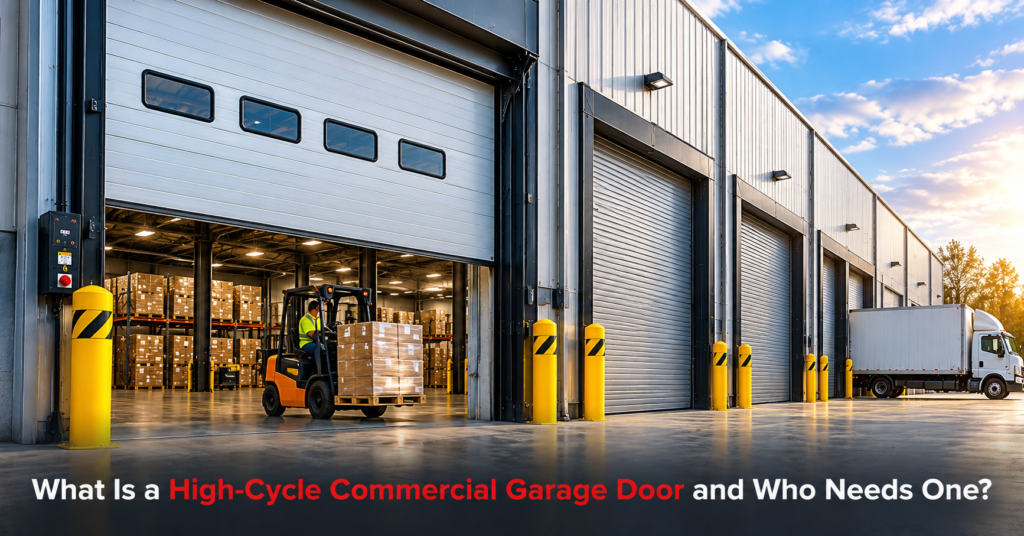
Not every commercial garage door lives an easy life. Some open and close a handful of times a day. Others cycle constantly, hour after hour, without much of a break. Standard-duty doors are built for the first scenario. A high-cycle commercial garage door is built specifically for the second — and using the wrong one for the job tends to show up fast in the form of premature wear and repeated service calls.
At VP Commercial Garage Doors, this is one of the most important — and most overlooked — decisions a facility can get wrong. This guide explains exactly what makes a door “high-cycle,” how it differs from a standard-duty system, and which types of businesses genuinely need one.
What Makes a Door “High-Cycle”?
A cycle refers to one complete open-and-close sequence of a garage door. Every component involved — springs, rollers, hardware, the opener — is engineered with a specific cycle rating in mind, essentially an estimate of how many times it can perform that sequence before it’s expected to wear out. Standard-duty torsion springs are typically rated for around 10,000 cycles. High-cycle springs are built to handle significantly more, often in the range of 25,000 to 50,000 cycles or beyond, using thicker or longer wire specifically engineered to handle repeated stress without fatiguing as quickly.
A high-cycle commercial garage door applies this same principle across the entire system, not just the springs, so the whole door is built to handle sustained, frequent use rather than occasional operation.
What’s Different About High-Cycle Construction
Reinforced Springs
High-cycle springs are larger, heavier, and built specifically to manage the tension and stress of constant winding and unwinding without fatiguing at the same rate as standard springs.
Heavier-Duty Curtain or Panel Materials
For rolling and coiling doors especially, high-cycle models are constructed with stronger, heavier-duty slats and components designed to withstand hundreds of cycles in rapid succession without the wear a standard-duty curtain would experience.
Commercial-Grade Operators Built for Constant Use
A high-cycle door needs an opener built to match. Commercial-grade operators designed for high-cycle use are rated to handle far more daily activity than light commercial or residential-style units, which are only built for a modest number of cycles per day.
Reinforced Bearings and Hardware
Bearings, rollers, and hardware on a high-cycle door are built to handle sustained friction and movement without the accelerated wear that constant use would cause on standard-duty components.
Standard-Duty vs. High-Cycle: Side-by-Side
| Factor | Standard-Duty | High-Cycle |
|---|---|---|
| Typical spring rating | Around 10,000 cycles | 25,000 to 50,000+ cycles |
| Ideal daily use | Light, occasional operation | Frequent, near-constant operation |
| Operator type | Light-duty or residential-style | Commercial-grade, built for sustained use |
| Component build | Standard hardware and bearings | Reinforced hardware and bearings |
| Best suited for | Low-traffic entrances | High-traffic bays and constant-cycle applications |
Who Actually Needs a High-Cycle Door
Distribution Centers and Warehouses
Facilities with constant truck traffic and frequent dock activity put far more daily stress on a door than a typical commercial entrance, making high-cycle construction a practical necessity rather than an upgrade.
Parking Garages and Structures
Entry and exit gates in parking facilities can cycle continuously throughout the day, especially in high-traffic locations, which quickly exceeds what a standard-duty door and opener are built to handle.
Fire Stations and Emergency Services
Fire station doors need to open and close reliably, often multiple times per shift, with virtually no tolerance for unexpected failure. High-cycle construction supports the dependability these facilities require.
Manufacturing Facilities
Constant movement of materials, equipment, and vehicles through manufacturing bays creates a demanding daily cycle count that standard-duty doors typically aren’t built to sustain long-term.
Car Washes and Automotive Service Centers
Facilities processing a high volume of vehicles daily, like conveyor car washes, cycle their doors with nearly every vehicle that passes through, creating one of the most demanding use cases for door hardware.
Municipal and Government Facilities
Public facilities with frequent vehicle or equipment movement — maintenance yards, transit facilities, and similar operations — often see cycle counts well beyond what standard-duty systems are designed for.
Signs Your Facility Has Outgrown a Standard-Duty Door
- Repeated spring or hardware failures well before they should be wearing out
- Frequent opener issues despite regular maintenance
- A door that’s cycling dozens or more times per day, every day
- Increasing service calls for the same recurring issues
If these signs sound familiar, it’s worth having a professional evaluate whether your current door is actually rated for how it’s being used.
High-Cycle Doesn’t Have to Mean High-Speed
It’s worth clarifying a common point of confusion: high-cycle and high-speed describe different things. High-cycle refers to how many times a door can operate reliably over its lifespan. High-speed refers to how quickly it opens and closes. The two can absolutely be combined for facilities that need both rapid cycling and long-term durability, but a door can be high-cycle without necessarily being high-speed, and vice versa.
Why Serviceability Matters as Much as Cycle Rating
Cycle rating and horsepower specs get a lot of attention, but serviceability often matters just as much in real-world use. A door that’s easy to service, with straightforward manual operation available during a power outage, keeps a high-traffic facility running even when something goes wrong. Facilities managing multiple locations also benefit from standardizing on operator platforms that support a range of applications, which simplifies training and keeps technicians familiar with the same systems across sites. This is part of the broader picture we cover in our guide to high-traffic warehouse door maintenance, since the right equipment still depends on consistent upkeep to perform as designed.
Why Working With a Commercial Specialist Matters
Determining whether a facility actually needs high-cycle equipment — and which specific components matter most — depends on understanding real daily usage, not just guessing based on general size or industry. VP Commercial Garage Doors helps businesses evaluate their actual cycle demands and match them to the right door and operator configuration, building on the broader decision-making framework in our guide to commercial garage door types.
FAQs About High-Cycle Commercial Garage Doors
How do I know if my facility needs a high-cycle door instead of a standard one?
If your door cycles frequently throughout the day, or you’re experiencing repeated component failures well ahead of schedule, a high-cycle system is likely a better fit.
Are high-cycle springs the only difference between standard and high-cycle doors?
No. A true high-cycle door typically includes reinforced hardware, a commercial-grade operator, and stronger panel or curtain materials, not just upgraded springs.
Can a standard-duty door be upgraded to high-cycle components?
In some cases, specific components like springs can be upgraded, but a facility with genuinely high daily use often benefits more from a fully high-cycle system designed to work together.
Is a high-cycle door the same as a high-speed door?
No. High-cycle refers to how many operations a door can reliably handle over time, while high-speed refers to how quickly it opens and closes. They’re separate features that can be combined.
What industries most commonly need high-cycle doors?
Distribution centers, parking structures, fire stations, manufacturing facilities, car washes, and municipal facilities are among the most common users of high-cycle commercial doors.
Contact VP Commercial Garage Doors
If your business needs dependable Commercial Garage Door Repair, Commercial Overhead Door Installation, Commercial Garage Door Maintenance, Rolling Steel Door Repair, High-Speed Commercial Doors, Dock Leveler Repair, Loading Dock Equipment Service, or Emergency Commercial Garage Door Repair, trust the experienced team at VP Commercial Garage Doors.
We proudly serve businesses throughout Elk Grove Village, Schaumburg, Naperville, Aurora, Buffalo Grove, Addison, Franklin Park, Palatine, Wheeling, Oak Brook, and surrounding Illinois communities.
Phone: 847 380 6448
Website: VP Commercial Garage Doors
Call VP Commercial Garage Doors today to schedule professional commercial garage door service and keep your warehouse or industrial facility operating safely, efficiently, and without costly interruptions.
Final Thoughts
A high-cycle commercial garage door isn’t a general upgrade — it’s a specific answer to a specific problem: doors that operate far more often than standard-duty equipment was ever designed to handle. Recognizing when a facility has outgrown standard-duty components is the first step toward avoiding repeated failures and keeping high-traffic operations running reliably.
If your facility’s door seems to be struggling to keep up with daily demand, it’s worth having a professional assess whether high-cycle equipment is the right fit.
Summary
A high-cycle commercial garage door is built with reinforced springs, hardware, and operators designed to handle frequent daily use, unlike standard-duty doors rated for occasional operation. Facilities like distribution centers, parking structures, fire stations, manufacturing plants, and car washes typically need high-cycle doors due to their constant, high-frequency door activity.