

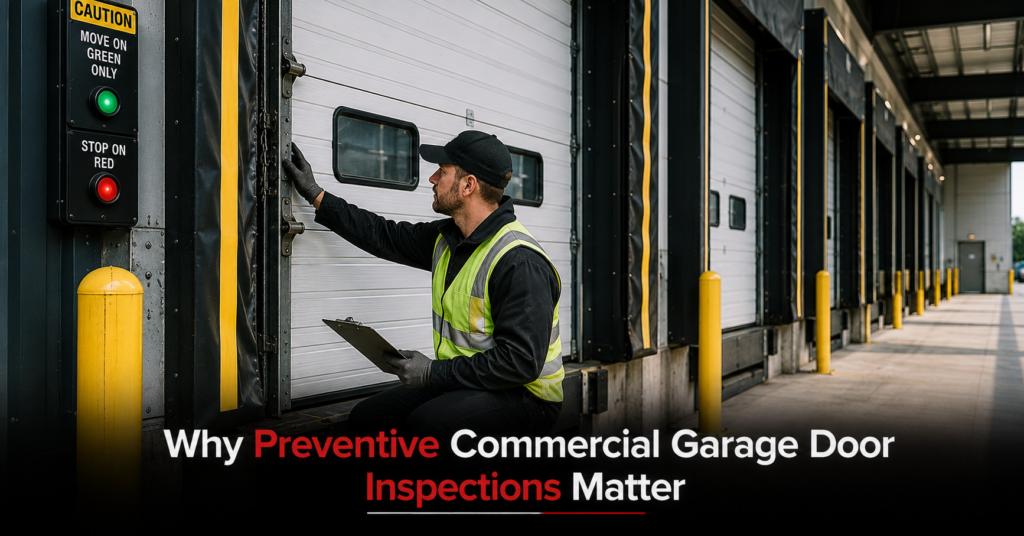
Most businesses only think about their garage door when it stops working. By then, the issue has usually been building for a while — a spring nearing the end of its life, a sensor drifting out of alignment, hardware that’s slowly worked itself loose. Preventive inspections exist to catch exactly this kind of problem, long before it turns into a breakdown, a safety incident, or a compliance gap nobody noticed until it mattered.
At VP Commercial Garage Doors, the value of preventive inspections becomes obvious the moment you compare two facilities side by side: one that inspects consistently, and one that waits until something goes wrong. The difference isn’t subtle. This guide explains exactly why preventive commercial garage door inspections matter, beyond the obvious “catch problems early” reasoning most people already assume.
What Preventive Inspection Actually Means
A preventive inspection is a scheduled, proactive evaluation of a door’s condition — springs, cables, tracks, hardware, opener, and safety systems — performed on a set schedule rather than triggered by a visible problem. It’s fundamentally different from a repair call, which only happens after something has already gone wrong. The value of an inspection comes specifically from catching issues while they’re still developing, not from fixing what’s already broken.
The Safety Value: Catching Failure Before It Happens
Most serious commercial garage door incidents share a pattern — a component that showed measurable wear before it failed completely. Torsion springs fatigue gradually. Cables fray before they snap. Sensors drift out of alignment before they stop working entirely. A preventive inspection is designed to catch exactly these warning signs, at the point where they’re still a routine fix rather than a hazard.
The Reliability Value: Protecting Daily Operations
A door that fails unexpectedly doesn’t just need a repair — it disrupts loading schedules, blocks bays, and pulls staff away from other tasks. Facilities with consistent inspection routines experience far fewer of these disruptions, since most commercial garage door downtime traces back to a warning sign that went unnoticed rather than a truly random failure.
The Compliance Value: Staying Ahead of Code and Safety Requirements
This is one of the most overlooked benefits of preventive inspection. Fire-rated doors, for example, need to maintain specific compliance standards, and a failure discovered proactively during a routine inspection is a very different situation than one discovered during a compliance audit or after an incident. Preventive inspections give facilities the chance to identify and correct compliance gaps on their own terms, rather than being caught off guard.
The Insurance and Risk Management Value
Documented preventive maintenance programs carry value that goes beyond the physical inspection itself. Some commercial property and liability insurers factor documented maintenance history into their risk assessments, since a facility that can demonstrate consistent, proactive care presents a different risk profile than one with no service records at all. A provider who maintains detailed inspection and service history is providing a resource that supports this kind of risk management, not just the mechanical work.
The Lifespan Value: Protecting a Long-Term Asset
Every inspection that catches a developing issue early protects the broader system from the kind of compounding wear that shortens a door’s useful life. This connects directly to what we cover in our guide on how to increase the lifespan of your commercial overhead door, since consistent inspection is one of the foundational habits that separates a door that lasts from one that doesn’t.
Why Businesses Skip Preventive Inspections Anyway
Despite these clear benefits, many facilities still skip preventive inspections, usually for one of a few reasons:
“It’s working fine.” A door that opens and closes normally can still be developing serious internal wear that isn’t visible or audible yet.
“We’ll deal with it if something breaks.” This reactive approach almost always means dealing with an issue during a disruption, rather than on a planned schedule.
“Inspections feel like an extra task.” In practice, a routine inspection takes far less time and disruption than an emergency repair call, especially when it’s scheduled around normal operations rather than forced by a breakdown.
None of these reasons hold up well against the actual risk of skipping inspections altogether, especially in a commercial setting where the consequences of a failure extend beyond the door itself.
What a Consistent Inspection Program Looks Like
A strong preventive inspection program includes routine internal checks handled by trained staff, combined with a scheduled professional inspection covering springs, cables, balance, and safety systems. For a full breakdown of what belongs in each type of check, our complete guide to commercial garage door safety inspections covers the daily-through-annual structure in detail.
Why Working With a Commercial Specialist Matters
Preventive inspections are only as valuable as the consistency behind them. VP Commercial Garage Doors helps facilities build inspection routines that actually get followed, with clear documentation that supports safety, compliance, and long-term reliability — not just a one-time check that gets forgotten until the next problem appears.
Where We Help Businesses Build Preventive Inspection Programs
We work with facilities throughout the Chicagoland area, including Skokie, Des Plaines, Buffalo Grove, and Hoffman Estates, along with many surrounding communities. Wherever your facility is located, our team can help you build a preventive inspection routine that protects your people, your operations, and your equipment.
FAQs About Preventive Commercial Garage Door Inspections
How is a preventive inspection different from routine maintenance?
Inspection is the evaluation step — identifying wear and potential issues. Maintenance is the follow-up action, like lubrication or adjustment. A strong program includes both, working together.
Does documentation from inspections really matter for insurance purposes?
Yes. Many insurers consider documented maintenance history as part of their risk assessment, since it demonstrates proactive management rather than reactive repairs.
How often should a commercial garage door receive a preventive inspection?
Frequency depends on usage, with high-cycle doors generally needing more frequent professional inspections than lower-traffic doors, in addition to routine internal checks.
Can preventive inspections really catch problems that aren’t visible yet?
Yes. Trained technicians know what to check beyond the obvious — spring tension, cable condition, and sensor calibration — which often reveals developing issues long before they’d be noticeable during normal use.
Is preventive inspection worth it for a door that’s never had problems?
Yes. A trouble-free history doesn’t mean a door is immune to gradual wear — it often just means the wear hasn’t reached a noticeable stage yet.
Contact VP Commercial Garage Doors
If your business needs dependable Commercial Garage Door Repair, Commercial Overhead Door Installation, Commercial Garage Door Maintenance, Rolling Steel Door Repair, High-Speed Commercial Doors, Dock Leveler Repair, Loading Dock Equipment Service, or Emergency Commercial Garage Door Repair, trust the experienced team at VP Commercial Garage Doors.
We proudly serve businesses throughout Elk Grove Village, Schaumburg, Naperville, Aurora, Buffalo Grove, Addison, Franklin Park, Palatine, Wheeling, Oak Brook, and surrounding Illinois communities.
Phone: 847 380 6448
Website: VP Commercial Garage Doors
Call VP Commercial Garage Doors today to schedule professional commercial garage door service and keep your warehouse or industrial facility operating safely, efficiently, and without costly interruptions.
Final Thoughts
Preventive commercial garage door inspections matter because they shift a facility from reacting to problems to catching them before they happen. The value isn’t limited to avoiding a single repair — it extends to safety, compliance, insurance risk management, and the long-term reliability of a system your business depends on every day.
If it’s been a while since your door received a real preventive inspection, that’s the clearest sign it’s time to schedule one.
Summary
Preventive commercial garage door inspections matter because they catch developing issues like spring fatigue, cable wear, and sensor misalignment before they cause failures. Beyond safety, they support compliance, insurance risk management, and long-term reliability, making them more valuable than reactive repairs alone.