

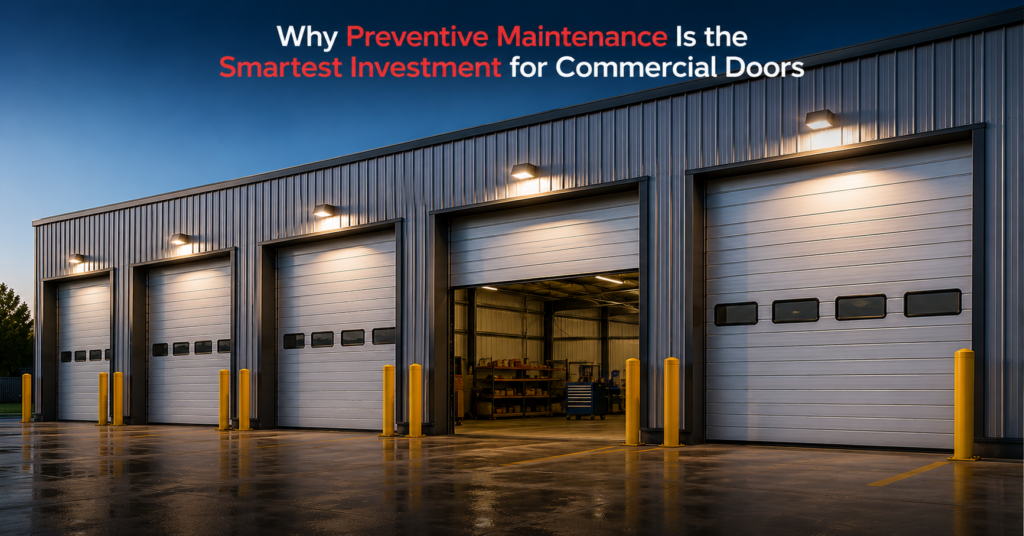
A commercial garage door doesn’t get much attention until it stops working. Then it becomes the only thing anyone in the building is thinking about — trucks stuck outside, employees standing around, and a technician bill that could have been avoided.
That’s the real cost of skipping maintenance. It’s not just the repair invoice. It’s the lost hours, the missed deliveries, and the safety risk of a door that fails without warning.
Preventive maintenance flips that script. Instead of reacting to breakdowns, you catch small issues before they turn into expensive, disruptive failures. For any business that depends on a commercial overhead door — warehouses, distribution centers, auto shops, manufacturing plants, retail loading docks — a scheduled maintenance plan isn’t an extra expense. It’s one of the cheapest forms of insurance a facility can buy.
In this guide, we’ll break down what preventive maintenance actually involves, why it saves money over time, what a professional inspection covers, and how often your commercial garage door should be serviced.
What Is Preventive Maintenance for Commercial Garage Doors?
Preventive maintenance is a scheduled inspection and tune-up process designed to catch wear and tear before it causes a breakdown. It’s the difference between fixing a problem and preventing one.
A typical maintenance visit covers the entire door system, not just the panels. That includes:
- Springs and cables (the components under the most tension)
- Rollers, hinges, and tracks
- The garage door opener and drive system
- Sensors and safety reversal features
- Weatherstripping and seals
- Bolts, brackets, and hardware connections
Rather than waiting for a spring to snap or a track to bend, a technician identifies stress points early and adjusts, lubricates, or replaces parts before they fail completely.
Why Reactive Repairs Cost More Than Prevention
Most business owners don’t skip maintenance because they don’t care — they skip it because it feels optional. Reactive repair feels “free” until the day it isn’t.
Here’s the reality: a broken spring, a misaligned track, or a failed opener rarely happens at a convenient time. It usually happens during peak hours, mid-shift, or right when a delivery truck is waiting at the dock.
Emergency repairs typically cost more than routine service for a few reasons:
- Rush labor rates. Same-day or after-hours service often comes at a premium.
- Bigger damage. A small issue left unchecked (like a worn cable) can damage the opener motor, the track, or even the door panel itself.
- Downtime. Every hour a bay door is stuck shut or open is an hour of lost productivity, blocked shipping, or a safety exposure.
A preventive maintenance plan spreads these costs out predictably instead of hitting you with a surprise bill — and a surprise closure.
Key Benefits of a Preventive Maintenance Program
Fewer Emergency Breakdowns
The most obvious benefit is also the most valuable one. Regular inspections catch frayed cables, worn rollers, and loose hardware long before they cause a full system failure. Fewer surprises mean fewer emergency calls and less disruption to daily operations.
Longer Lifespan for Doors, Springs, and Openers
Commercial doors cycle dozens or even hundreds of times a day. That constant use adds up fast. Routine lubrication, alignment checks, and balance adjustments reduce strain on the springs and opener motor, which extends the working life of the entire system by years, not months.
Improved Safety and Compliance
A commercial garage door is a large moving structure, and safety sensors, auto-reverse features, and cable tension all need to function correctly. Regular maintenance ensures these safety systems are tested and working, which matters both for OSHA-related workplace safety standards and for protecting employees and visitors from accidents.
Lower Long-Term Repair Costs
It’s almost always cheaper to replace a $30 roller during a routine visit than to deal with the aftermath of a track failure that damages the door panel and the opener. Preventive care keeps small problems small.
Better Energy Efficiency
Worn weatherstripping and misaligned doors let in drafts, which drives up heating and cooling costs in warehouses and climate-controlled facilities. Tight seals and properly balanced doors help maintain internal temperature and reduce energy waste.
What a Professional Maintenance Visit Includes
A thorough commercial garage door maintenance visit typically includes:
- Visual inspection of panels, tracks, and hardware for wear or damage
- Spring tension and balance testing to confirm the door opens and closes evenly
- Lubrication of rollers, hinges, and bearings
- Opener and sensor testing, including auto-reverse safety checks
- Cable and pulley inspection for fraying or stretching
- Weatherstripping and seal checks to prevent drafts and moisture intrusion
- Bolt and fastener tightening, since daily vibration loosens hardware over time
A qualified technician documents any issues found and recommends repairs before they become urgent, rather than waiting for a failure.
How Often Should a Commercial Garage Door Be Serviced?
Most facilities benefit from a maintenance check every three to six months, though the right frequency depends on usage. A distribution center with doors cycling constantly all day needs more frequent attention than a smaller facility with lighter traffic.
As a general guide:
- High-traffic doors (warehouses, loading docks): every 3 months
- Moderate-traffic doors (retail, light industrial): every 6 months
- Low-traffic doors: at least once a year
If you’re unsure where your facility falls, a technician can assess your door’s usage pattern and recommend a schedule tailored to your operation.
Common Mistakes Businesses Make With Door Maintenance
Waiting for a visible problem. By the time a door is making noise or sticking, the underlying issue has usually been building for a while.
Only calling for repairs, never for check-ups. Repair and maintenance are not the same thing. Repairs fix what’s already broken; maintenance prevents the break in the first place.
Ignoring the opener system. Many businesses focus on the door itself and forget the opener, sensors, and safety reversal mechanism, which are just as prone to wear.
Using the wrong lubricant — or none at all. DIY lubrication with the wrong product (like WD-40 on springs) can actually attract dirt and cause more friction over time. Professional-grade silicone or lithium-based lubricants are built for this job.
Skipping documentation. Facilities that keep a maintenance log make it easier to spot patterns, plan budgets, and prove compliance if a safety audit ever comes up.
Choosing the Right Commercial Garage Door Maintenance Partner
Not every garage door company is equipped to handle commercial-grade systems. Commercial doors are larger, heavier, and built differently than residential doors, so it’s worth working with a team that specializes specifically in commercial garage door repair and maintenance rather than a residential-focused provider.
Look for a company that offers:
- Experience with commercial-grade doors, openers, and loading dock equipment
- Prompt response times and same-day service availability
- Transparent estimates before any work begins
- A documented inspection process, not just a quick visual check
At VP Commercial Garage Doors, our team works exclusively with businesses across Illinois — from installation and spring replacement to opener service and scheduled maintenance plans built around how your facility actually operates.
Where We Provide Commercial Garage Door Maintenance
VP Commercial Garage Doors provides commercial garage door repair and maintenance services throughout the Chicagoland area, including Naperville, Aurora, Schaumburg, Arlington Heights, Elgin, Skokie, Elmhurst, Des Plaines, Buffalo Grove, Hoffman Estates, Glenview, and Mount Prospect, along with many surrounding communities. Whether your facility is in Elk Grove Village, Wheaton, Bolingbrook, or Northbrook, our technicians are equipped to handle everything from routine inspections to emergency repairs.
FAQs About Commercial Garage Door Preventive Maintenance
How much does preventive maintenance typically cost compared to a repair?
Routine maintenance visits are generally far less expensive than emergency repairs, since they involve inspection and minor adjustments rather than replacing failed components under time pressure.
Can preventive maintenance really prevent all breakdowns?
No maintenance plan eliminates every risk, but it significantly reduces the chances of sudden failures by catching wear-and-tear issues early.
Is preventive maintenance necessary if the door seems to be working fine?
Yes. Many issues, like spring fatigue or worn cables, aren’t visible or audible until they’re close to failure. Regular inspections catch these hidden problems.
How long does a typical maintenance visit take?
Most commercial maintenance visits take between 30 minutes and a couple of hours, depending on the number of doors and the complexity of the opener system.
Does preventive maintenance help with insurance or safety compliance?
It can. Documented maintenance records demonstrate that safety systems, like auto-reverse sensors, are regularly tested, which is useful for workplace safety compliance and insurance purposes.
Contact VP Commercial Garage Doors
If your business needs dependable Commercial Garage Door Repair, Commercial Overhead Door Installation, Commercial Garage Door Maintenance, Rolling Steel Door Repair, High-Speed Commercial Doors, Dock Leveler Repair, Loading Dock Equipment Service, or Emergency Commercial Garage Door Repair, trust the experienced team at VP Commercial Garage Doors.
We proudly serve businesses throughout Elk Grove Village, Schaumburg, Naperville, Aurora, Buffalo Grove, Addison, Franklin Park, Palatine, Wheeling, Oak Brook, and surrounding Illinois communities.
Phone: 847 380 6448
Website: https://vpcommercialgaragedoors.com/
Call VP Commercial Garage Doors today to schedule professional commercial garage door service and keep your warehouse or industrial facility operating safely, efficiently, and without costly interruptions.
Final Thoughts
A commercial garage door works hard every single day, and like any piece of equipment under constant use, it needs regular attention to keep performing safely and reliably. Preventive maintenance isn’t about spending more — it’s about spending smarter, catching small issues while they’re still cheap and simple to fix.
If it’s been a while since your last inspection, now is a good time to schedule one. A short visit today can save your business from a costly, disruptive breakdown tomorrow.
Summary
Preventive maintenance for commercial garage doors involves regular inspection of springs, cables, tracks, and openers to catch wear before it causes breakdowns. It reduces emergency repair costs, extends equipment lifespan, improves safety compliance, and keeps business operations running smoothly without unexpected door failures.