

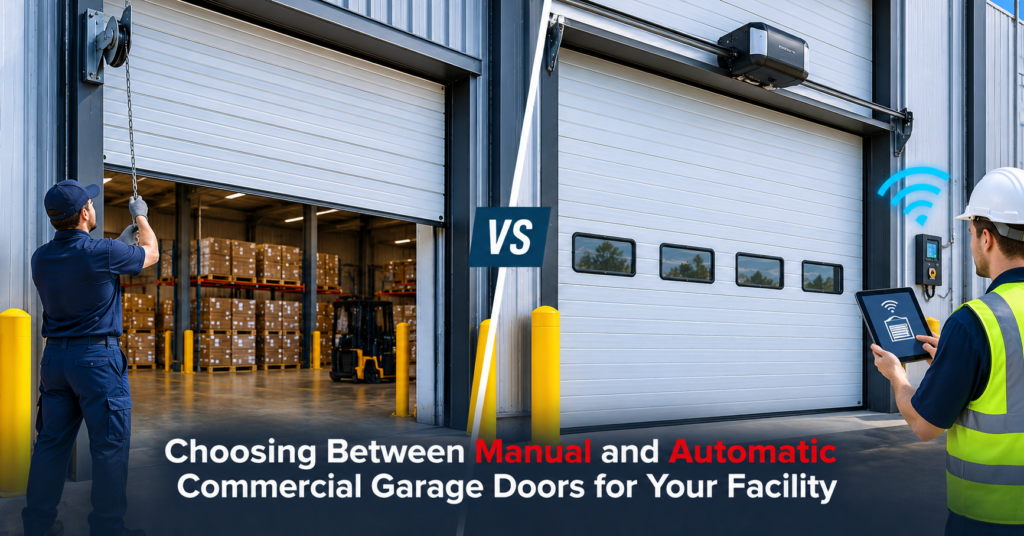
Picking the right door for a commercial building isn’t just about size and material — it’s also about how it operates. Manual and automatic commercial garage doors both get the job done, but they suit very different types of facilities. At VP Commercial Garage Doors, this is one of the most common questions we hear from business owners planning a new install or replacing an aging door. This guide walks through the manual vs automatic garage doors decision so you can match the right option to your facility’s daily demands.
Understanding the Basics
Before comparing the two, it helps to know what each option actually involves.
A manual garage door is opened and closed by hand, usually with a pull chain, handle, or push-up mechanism. It relies on spring tension to balance the door’s weight, making it lighter to lift than its size suggests.
An automatic garage door uses a motorized opener to raise and lower the door at the press of a button, a remote, or a connected access system. Many automatic setups also integrate with keypads, sensors, or building access controls.
Both types can use the same door materials and panel styles — the real difference is in how they’re operated day to day.
Key Factors to Consider
1. Frequency of Use
This is usually the deciding factor. A door that opens and closes dozens of times a day — like at a loading dock or a distribution center — puts a lot of strain on anyone operating it manually. Automatic openers handle that repetition without wearing down staff or slowing operations.
For lower-traffic doors, such as a storage building opened once or twice a day, manual operation may be perfectly practical.
2. Facility Type and Workflow
Warehouses, manufacturing plants, and fire stations typically benefit from automatic doors because speed and consistency matter. A garage door opener repair issue on a busy dock can bring operations to a halt, so reliability here is worth prioritizing from the start.
Smaller facilities, equipment sheds, or buildings with limited staff traffic often do fine with manual doors, especially where budget-conscious simplicity is the goal.
3. Staffing and Labor Considerations
Manual doors require someone physically present to operate them every time. If a facility runs with a small crew or relies on drivers who need quick, independent access, an automatic system reduces bottlenecks and keeps traffic moving.
4. Weather and Regional Conditions
Facilities across the Chicago suburbs deal with real seasonal swings — heavy snow, ice, and wind. Manual doors can become harder to operate in these conditions, especially if tracks or springs are affected by cold weather. Automatic doors with weatherproof components tend to hold up more consistently through Illinois winters.
5. Safety Requirements
Automatic doors typically come with built-in safety sensors that stop or reverse the door if something is in the way — an important feature in facilities with heavy equipment or pedestrian traffic near the door. Manual doors depend entirely on the operator’s attention, which introduces more room for error.
Benefits of Manual Commercial Garage Doors
- Simpler mechanical design with fewer components to maintain
- No dependency on electricity or backup power during outages
- Lower likelihood of opener-related commercial garage door repair calls
- Well suited to low-traffic, low-urgency facilities
Benefits of Automatic Commercial Garage Doors
- Faster operation, which matters for high-traffic docks and entry points
- Reduced physical strain on staff
- Integration with access control, security systems, and remote monitoring
- Built-in safety sensors and auto-reverse features
- Better suited to facilities that need consistent, repeated use throughout the day
Common Mistakes Businesses Make
- Choosing based on upfront simplicity alone. A manual door might seem easier at first, but daily operational strain adds up fast in high-traffic settings.
- Underestimating usage frequency. Businesses often expect fewer daily openings than what actually happens once operations ramp up.
- Ignoring long-term maintenance needs. Automatic systems need periodic opener checks, while manual doors need spring and track attention — neither is maintenance-free.
- Overlooking safety requirements. Facilities with forklifts or heavy foot traffic near the door benefit significantly from automatic safety sensors.
- Not planning for future growth. A door that works for current volume might not keep up if the facility scales up operations.
Expert Tips for Making the Right Choice
- Track how many times your door actually opens and closes in a typical day before deciding
- Factor in staffing levels — fewer staff often means automatic is the more practical choice
- Ask about backup power or manual override options for automatic doors, in case of outages
- Consider combining automatic doors with a preventive maintenance plan to catch wear before it causes downtime
- If you’re unsure, a walkthrough with a technician can clarify what your specific facility actually needs
FAQs
Are automatic commercial garage doors more reliable than manual ones?
Automatic doors offer more consistency for high-traffic use, but reliability also depends on proper maintenance for either type.
Can a manual garage door be converted to automatic later?
In many cases, yes — a compatible opener can often be added to an existing manual door, though it depends on the door’s current setup.
Do automatic doors still work during a power outage?
Most automatic systems include a manual release or backup option, but it’s worth confirming this feature when choosing an opener.
Which option needs less maintenance?
Both need regular upkeep. Manual doors rely on spring and track condition, while automatic doors also require opener and sensor checks.
Is one option safer than the other?
Automatic doors generally offer more built-in safety features, like auto-reverse sensors, which can reduce risk in busy work environments.
Contact VP Commercial Garage Doors
If your business needs dependable Commercial Garage Door Repair, Commercial Overhead Door Installation, Commercial Garage Door Maintenance, Rolling Steel Door Repair, High-Speed Commercial Doors, Dock Leveler Repair, Loading Dock Equipment Service, or Emergency Commercial Garage Door Repair, trust the experienced team at VP Commercial Garage Doors.
We proudly serve businesses throughout Elk Grove Village, Schaumburg, Naperville, Aurora, Buffalo Grove, Addison, Franklin Park, Palatine, Wheeling, Oak Brook, and surrounding Illinois communities.
Phone: 847 380 6448
Website: VP Commercial Garage Doors
Call VP Commercial Garage Doors today to schedule professional commercial garage door service and keep your warehouse or industrial facility operating safely, efficiently, and without costly interruptions.
Conclusion
There’s no universal right answer between manual and automatic commercial garage doors — it comes down to how often the door is used, how your facility operates, and what level of safety and convenience your team needs. High-traffic facilities usually benefit most from automatic systems, while manual doors can be a practical fit for lower-use spaces. When the choice isn’t clear, a professional assessment can help match the door to your facility’s real-world demands.
Summary
Automatic commercial garage doors suit high-traffic facilities needing speed, safety sensors, and reduced staff strain, while manual doors fit lower-use spaces with simpler maintenance needs. The right choice depends on daily usage frequency, staffing, and facility type — a professional evaluation helps confirm the best fit.