

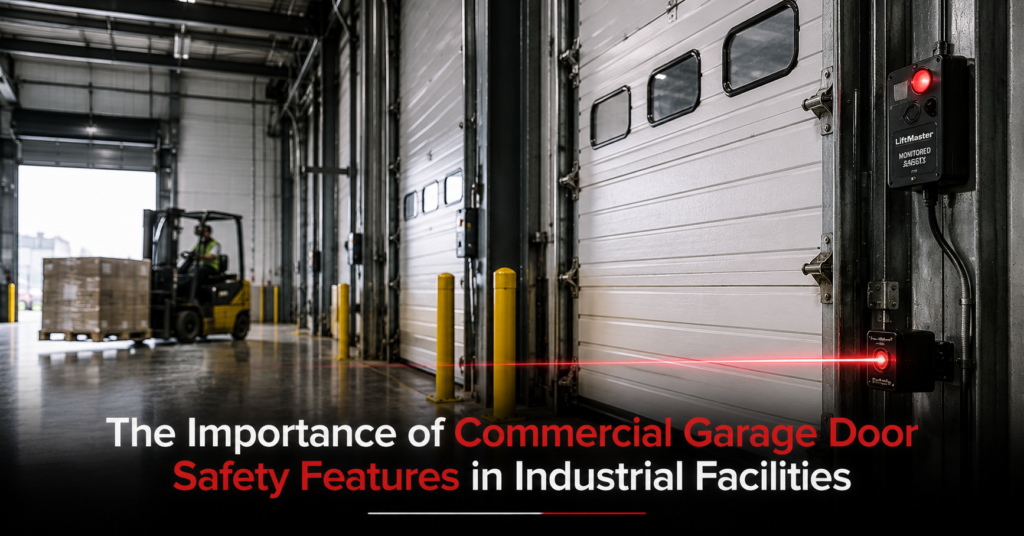
An industrial garage door isn’t just an entry point — it’s a large, heavy, constantly moving piece of equipment operating in one of the busiest parts of any facility. Forklifts pass through it dozens of times a day, employees walk near it constantly, and vehicles rely on it opening and closing every single time predictably. In that kind of environment, safety features aren’t an upgrade. They’re the difference between a door that protects people and one that puts them at risk.
At VP Commercial Garage Doors, we see the full range firsthand — facilities with doors built around genuine safety standards, and others still relying on outdated systems that were never designed for how hard the door is actually being used today. This guide covers why industrial garage door safety features matter so much, what they actually do, and how to evaluate whether your current setup measures up.
Why Industrial Facilities Face Higher Safety Stakes
Industrial and warehouse environments combine several risk factors that don’t exist in lighter commercial or residential settings: heavier doors, constant cycling, and a steady mix of forklifts, delivery vehicles, and foot traffic moving through the same space. A malfunction that might be a minor inconvenience elsewhere becomes a genuine hazard here, simply because of how much activity surrounds the door at any given moment. That’s exactly why industrial garage door safety deserves more attention than a standard commercial setup.
Essential Safety Features Every Industrial Door Should Have
Auto-Reverse and Photo-Eye Sensors
This is one of the most important safety systems on any commercial door. Photo-eye sensors monitor the door’s path as it closes, and if they detect an obstruction — a person, a piece of equipment, a vehicle — the door automatically reverses instead of continuing to close. In a facility with constant forklift and foot traffic, this feature alone prevents a significant share of potential injuries.
Edge Sensors
Mounted along the bottom edge of the door, these sensors detect pressure or contact and stop the door immediately if something is in its path. They work alongside photo-eye sensors to add a second layer of protection, which matters in high-traffic areas where visibility isn’t always perfect.
Safety Guards Over Moving Parts
Pinch points around springs, cables, and rollers pose a real risk to anyone working near the door. Protective guards covering these moving components reduce the chances of an accidental injury during normal operation or nearby activity.
Emergency Release Mechanism
If the opener fails or power goes out, an emergency release allows the door to be manually opened or closed without leaving a facility stuck. This mechanism should be simple to activate and positioned where trained staff can reach it quickly when needed.
Fall Protection and Counterbalance Systems
Industrial doors are heavy, and a sudden, uncontrolled drop can cause serious injury or damage. Counterbalance systems — using torsion springs or counterweights — are designed specifically to prevent free-falling and keep the door’s movement controlled and predictable.
Additional Features Worth Considering for Certain Facilities
Fire-Rated Doors
Facilities that store flammable materials or need to meet specific fire code requirements benefit from fire-rated doors designed to withstand extreme temperatures and help contain a fire’s spread between sections of a building. Doors with recognized UL or NFPA fire ratings are worth prioritizing in these environments.
Wind Load Reinforcement
For facilities in areas prone to strong storms, reinforced doors help withstand high wind pressure, protecting both the door itself and the structural integrity of the opening. This is a meaningful consideration in a region that regularly sees severe seasonal storms.
High-Visibility Markings and Warning Signage
Painting doors and surrounding areas in high-visibility colors, combined with clear warning signage, helps reduce collisions and near-misses in busy industrial environments where attention is often split between multiple tasks.
Access Control and Rolling Code Security
While primarily a security feature, access control systems — keypads, rolling code technology, or restricted authorization — also support safety by limiting garage door operation to trained, authorized personnel rather than anyone who happens to be nearby.
Why Safety Features Alone Aren’t Enough
Even the best-equipped door depends on how it’s used and maintained. Safety features can fail silently if they’re never tested, and employees can’t rely on features they haven’t been trained to use. Combining the right equipment with consistent commercial garage door maintenance and clear operational guidelines is what actually turns these features into reliable, everyday protection rather than a checkbox that was met once during installation.
Understanding UL 325 and Related Compliance Standards
Commercial garage door safety systems are generally expected to align with recognized standards, including UL 325, which addresses requirements like auto-reverse functionality and constant-pressure operation for certain door types. These standards exist specifically to reduce entrapment and injury risk in commercial and industrial settings. A qualified technician can help confirm whether your current equipment aligns with the standards relevant to your facility and how it’s used.
How to Evaluate Whether Your Current Door Meets Today’s Safety Standards
- Confirm auto-reverse and photo-eye sensors are present, aligned, and tested regularly
- Check for edge sensors along the bottom of the door
- Inspect for protective guards over springs, cables, and other moving parts
- Locate and test the emergency release mechanism
- Verify the counterbalance system is functioning and properly adjusted
- Consider whether fire rating or wind load reinforcement applies to your facility’s specific risks
- Review whether warning signage and high-visibility markings are clearly in place
If your facility can’t confidently check off most of this list, it’s worth scheduling a professional safety inspection to see where the gaps are.
Why Working With a Commercial Specialist Matters
Understanding which safety features matter — and confirming they’re actually functioning correctly — takes more than a quick glance at the door. VP Commercial Garage Doors helps industrial facilities evaluate their current safety setup, identify gaps against modern standards, and implement the features that genuinely reduce risk for the people working around the door every day.
Where We Help Industrial Facilities Stay Safe and Compliant
We work with facilities throughout the Chicagoland area, including Barrington Hills, Lake Barrington, Ridgefield, and Prairie Grove, along with many surrounding communities. Wherever your facility is located, our team can help you evaluate your current door’s safety features and close any gaps that put your team at risk.
FAQs About Commercial Garage Door Safety Features
What’s the most important safety feature on an industrial garage door?
Auto-reverse with photo-eye sensors is widely considered one of the most critical features, since it directly prevents the door from closing on a person or object.
Do all commercial garage doors need fire-rated construction?
Not all, but facilities storing flammable materials or subject to specific fire code requirements should prioritize doors with recognized fire ratings.
How often should safety features be tested?
Safety systems like auto-reverse and edge sensors should be tested regularly as part of routine maintenance, since they can fail silently without regular checks.
Is access control really a safety feature, or just security?
It serves both purposes. Restricting door operation to trained, authorized personnel reduces the chances of misuse or accidents caused by untrained operation.
Can older industrial doors be upgraded with modern safety features?
In many cases, yes. A professional evaluation can identify which safety systems can be added or upgraded on an existing door versus what might require more significant work.
Contact VP Commercial Garage Doors
If your business needs dependable Commercial Garage Door Repair, Commercial Overhead Door Installation, Commercial Garage Door Maintenance, Rolling Steel Door Repair, High-Speed Commercial Doors, Dock Leveler Repair, Loading Dock Equipment Service, or Emergency Commercial Garage Door Repair, trust the experienced team at VP Commercial Garage Doors.
We proudly serve businesses throughout Elk Grove Village, Schaumburg, Naperville, Aurora, Buffalo Grove, Addison, Franklin Park, Palatine, Wheeling, Oak Brook, and surrounding Illinois communities.
Phone: 847 380 6448
Website: https://vpcommercialgaragedoors.com/
Call VP Commercial Garage Doors today to schedule professional commercial garage door service and keep your warehouse or industrial facility operating safely, efficiently, and without costly interruptions.
Final Thoughts
Industrial garage door safety features exist because the stakes in these environments are genuinely higher — heavier doors, more traffic, and less room for error than in a typical commercial setting. Auto-reverse sensors, edge sensors, safety guards, and proper fall protection aren’t optional extras; they’re what stands between normal daily operation and a serious incident.
If it’s been a while since your facility’s door was evaluated against current safety standards, that’s the best place to start protecting the people who work around it every day.
Summary
Commercial garage door safety features are essential in industrial facilities due to heavier doors, constant use, and high foot and vehicle traffic. Key features include auto-reverse sensors, edge sensors, safety guards, emergency release mechanisms, and fall protection systems, all of which work together to prevent serious injuries and equipment damage.