

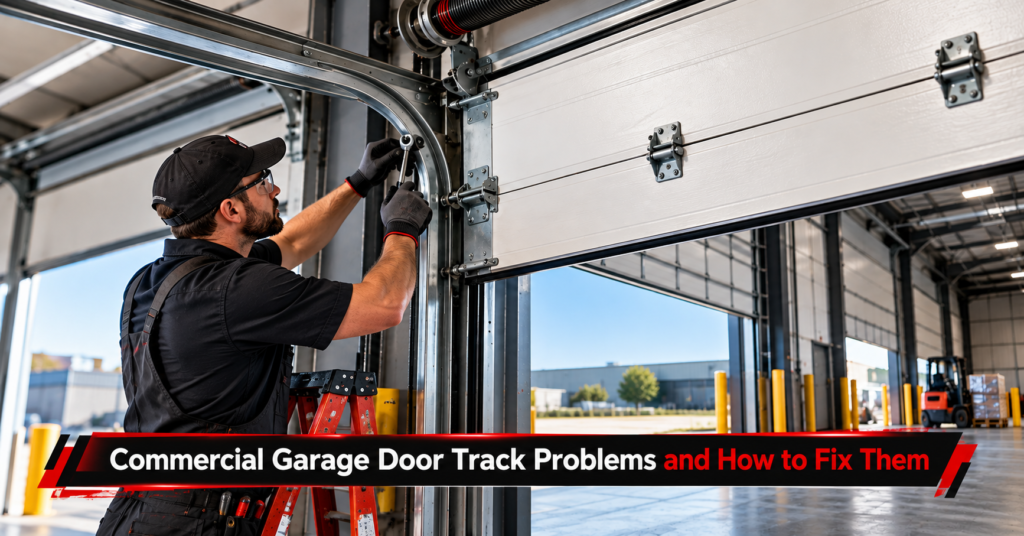
A commercial garage door is only as reliable as the tracks it rides on. When tracks bend, loosen, or fill with debris, the whole door starts to bind, shake, or jump off its path. Garage door track problems are one of the most common reasons commercial doors stop working, and they usually get worse the longer they’re ignored. At VP Commercial Garage Doors, we repair track issues for businesses every week. This guide explains what causes them, how to spot them, and what the right fix looks like.
How Commercial Garage Door Tracks Work
Tracks guide the rollers that carry the door up and down. A typical sectional door has a vertical track on each side, a horizontal track near the ceiling, and a curved section where the two meet.
Metal brackets hold the tracks to the wall and ceiling. For the door to move smoothly, the tracks must be:
- Straight, with no dents or bends
- Level and plumb
- Parallel to each other at the correct distance
- Firmly secured to the building
If any one of these conditions is off, the rollers can’t glide properly, and the door starts to struggle.
Common Garage Door Track Problems
1. Bent or Dented Tracks
A bump from a forklift, pallet, or delivery truck can bend a track in an instant. Even a small dent can catch a roller and make the door stick or jerk. Bent tracks are among the most frequent causes of an off-track door.
2. Misaligned Tracks
Over time, vibration can shift tracks out of position. If the two sides are no longer parallel, the door may rub, tilt, or bind as it moves. Misalignment often shows up as uneven gaps along the edges of the door.
3. Loose Brackets and Fasteners
Commercial doors cycle often, and that constant movement can slowly loosen bolts and brackets. Once a bracket loosens, the track can wobble or pull away from the wall, which throws off the door’s path.
4. Dirt, Debris, and Buildup
Dust, grit, and old lubricant can collect inside the track. This buildup creates friction and can cause rollers to skip or stall. Facilities near loading yards or construction areas see this more often.
5. Rust and Corrosion
Moisture, road salt, and humidity can corrode track surfaces, especially near the bottom of the vertical sections. Rough or pitted metal makes the rollers drag and wear faster.
6. Worn or Damaged Rollers
Rollers and tracks work as a pair. A worn roller can chew up a track, and a damaged track can wear out new rollers quickly. When rollers flatten, crack, or seize, a garage door roller replacement is often needed along with the track fix.
7. Door Off Track
When a door leaves its track entirely, it may hang crooked, sag at one corner, or stop moving. This is a serious safety risk, since the door can fall or shift without warning.
What Causes Track Problems in Commercial Settings
Commercial doors face more stress than most. The most common causes include:
- Impact damage from vehicles, forklifts, or equipment
- High cycle counts that loosen hardware over time
- Weather exposure, including snow, ice, and moisture
- Skipped maintenance, which lets small issues build up
- Improper installation, where tracks were never set at the correct alignment
Warning Signs of Track Trouble
Watch and listen for these signals:
- Grinding, scraping, or squealing as the door moves
- The door shaking or moving unevenly
- Visible gaps between the door and the track
- Rollers popping out or sitting at an angle
- Bent, dented, or twisted sections of track
- A door that sticks halfway or stops mid-cycle
- Loose or missing bolts along the track
If you see any of these, it’s time to have the door checked.
What You Can Safely Do Yourself
Some basic care is safe for trained facility staff:
- Keep the area around the door clear of debris
- Wipe visible dirt from the inside of the tracks with a dry cloth
- Look for obvious damage or loose hardware, without touching high-tension parts
- Report new noises or movement changes right away
Anything beyond that should be left to a technician. Tracks work together with springs and cables that carry heavy tension, and adjusting the wrong part can cause serious injury. Never try to bend a track back into shape or force an off-track door closed.
How Professionals Fix Garage Door Track Problems
A trained technician follows a clear process:
- Secure the door and the area. The door is made safe before any work begins.
- Inspect the full system. Tracks, brackets, rollers, springs, cables, and hinges are all checked, since a track issue often points to another worn part.
- Clean the tracks. Buildup is removed so the true condition of the metal is visible.
- Realign the tracks. Tracks are adjusted to be level, plumb, and parallel at the correct spacing.
- Tighten or replace brackets. Loose or damaged hardware is secured or swapped out.
- Replace worn rollers. New rollers help the door glide and protect the track from further wear.
- Replace damaged track sections. If a track is badly bent or corroded, a section or the full track is replaced.
- Test the balance and operation. The door is run through several cycles to confirm smooth, quiet movement.
During this process, a technician may also notice related issues, such as a worn spring that calls for garage door spring repair.
Repair or Replace: Knowing the Difference
Minor misalignment, loose brackets, and light debris buildup can usually be fixed with an adjustment and cleaning. Replacement makes more sense when:
- The track is severely bent or twisted
- Rust has weakened the metal
- The same section keeps failing after repairs
- The door has been off track more than once
When damage reaches that point, a fresh track set gives the door a solid foundation and helps prevent repeat problems.
Common Mistakes Businesses Make
- Hammering a bent track back into shape. This often weakens the metal and leaves the track out of true.
- Ignoring small noises. A scraping sound today can become an off-track door tomorrow.
- Using the door after it comes off track. Operating it can bend the track further and damage the panels.
- Over-lubricating the track. Too much grease attracts dust and creates sticky buildup. Rollers and hinges need lubrication, not the track surface itself.
- Skipping routine checks. Loose brackets are easy to fix early but hard to ignore once the door shifts.
- Treating track problems as isolated. Rollers, springs, and cables often need attention at the same time.
Expert Tips to Prevent Track Problems
- Install bollards or guards where vehicles pass close to the door
- Schedule a regular commercial garage door inspection to catch loose hardware early
- Add a preventive maintenance plan for steady, year-round care
- Train staff and drivers to keep clear of door tracks and edges
- Keep the track area clean, especially after winter weather
- Address new noises or movement changes immediately
- Record each repair so patterns become easy to spot
Local Track Repair for Chicagoland Facilities
VP Commercial Garage Doors provides fast commercial garage door repair for businesses in Wheeling, Oak Brook, Algonquin, and Bensenville, along with nearby communities. Our technicians understand how heavy daily use and Illinois weather affect commercial tracks. If a door has repeated track issues or is near the end of its service life, we can also talk through commercial garage door installation options that fit your facility.
FAQs
Can a bent garage door track be repaired?
Minor bends can sometimes be corrected by a technician, but badly bent or twisted tracks usually need to be replaced to restore safe operation.
Is it safe to keep using a door with track problems?
No. A damaged or misaligned track can cause the door to bind or fall. It’s safer to stop using the door until it’s inspected.
Why does my garage door keep coming off track?
Common causes include bent tracks, loose brackets, worn rollers, and misalignment. Repeated issues usually mean the root cause hasn’t been fixed yet.
Should I lubricate the garage door track?
Generally, no. Rollers, hinges, and springs need lubrication, while the track surface should stay clean and dry to avoid buildup.
How often should tracks be inspected?
Regular inspections are a good habit, and high-traffic doors benefit from more frequent checks than low-use doors.
Contact VP Commercial Garage Doors
If your business needs dependable Commercial Garage Door Repair, Commercial Overhead Door Installation, Commercial Garage Door Maintenance, Rolling Steel Door Repair, High-Speed Commercial Doors, Dock Leveler Repair, Loading Dock Equipment Service, or Emergency Commercial Garage Door Repair, trust the experienced team at VP Commercial Garage Doors.
We proudly serve businesses throughout Elk Grove Village, Schaumburg, Naperville, Aurora, Buffalo Grove, Addison, Franklin Park, Palatine, Wheeling, Oak Brook, and surrounding Illinois communities.
Phone: 847 380 6448
Website: VP Commercial Garage Doors
Call VP Commercial Garage Doors today to schedule professional commercial garage door service and keep your warehouse or industrial facility operating safely, efficiently, and without costly interruptions.
Conclusion
Tracks are easy to overlook, but they control how every part of the door moves. Bent metal, loose brackets, worn rollers, and debris buildup can all cause a door to bind or leave its path, and a small issue can quickly become a safety concern. Quick action, regular inspections, and professional repair help keep commercial doors running smoothly and keep your team safe. If your door is showing any warning signs, a prompt visit from a trained technician is the safest next step.
Summary
Commercial garage door track problems include bent tracks, misalignment, loose brackets, debris buildup, rust, and worn rollers. Fixes range from cleaning and realignment to bracket tightening and track replacement. Because tracks work with high-tension parts, a trained technician should handle repairs to keep the door safe.