

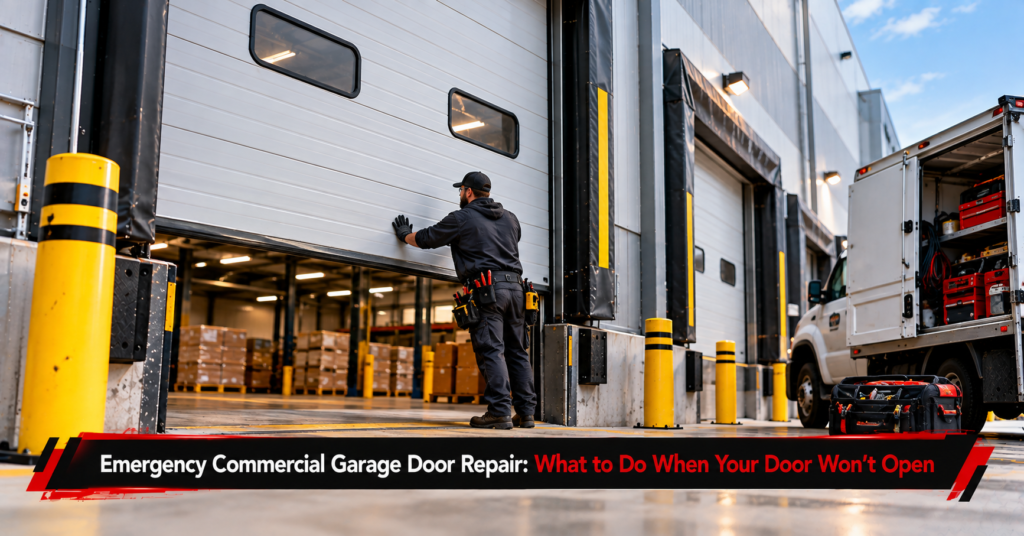
When your door jams during a busy shift, emergency garage door repair is the fastest way to get your facility moving again. A stuck commercial door can block deliveries, trap equipment, and leave your building unsecured. At VP Commercial Garage Doors, we help businesses through this situation often, and the first few minutes matter. This guide shows what to check, what to avoid, and when to call a technician.
Why a Commercial Garage Door Stops Opening
A door that won’t open is almost always a symptom of one of a handful of problems. Knowing the likely cause helps you give a technician useful details.
Broken Springs
Springs carry the full weight of the door. When one snaps, the door feels extremely heavy or won’t lift at all. You may hear a loud bang just before it happens. This is one of the most common causes, and it needs professional garage door spring repair.
Snapped or Frayed Cables
Lift cables work with the springs to raise the door. A broken cable can leave one side hanging lower than the other, which makes the door tilt or jam.
Opener or Motor Failure
If the motor hums but the door doesn’t move, or nothing happens at all, the opener may have a worn gear, a failed motor, or an electrical fault. This usually calls for garage door opener repair.
Off-Track Door
A bent track, loose bracket, or damaged roller can push the door off its path. An off-track door often sits crooked, scrapes, or stops partway through the cycle.
Sensor Problems
Safety sensors that are dirty, blocked, or misaligned can stop the door from closing. In some setups, they can also prevent normal operation altogether.
Power and Control Issues
A tripped breaker, dead remote battery, damaged wiring, or faulty wall control can all make a door look broken when the door itself is fine.
Frozen or Jammed Parts
In winter, ice can freeze the bottom seal to the ground, and moisture can lock up tracks and rollers. Debris in the track can cause a similar jam.
What to Do First: A Safe Step-by-Step Response
When the door won’t open, stay calm and work through these steps in order.
- Stop pressing the button repeatedly. Repeated attempts can burn out the motor or make a mechanical problem worse.
- Keep people and equipment clear. Move staff, vehicles, and forklifts away from the door.
- Check the basics. Confirm the opener has power, the breaker hasn’t tripped, and the remote or wall control has working batteries and a good connection.
- Look at the sensors. Make sure the lenses are clean, unblocked, and showing their indicator lights.
- Look for obvious blockage. Check for debris, ice, or objects in the track and under the door.
- Inspect from a safe distance. Look for a sagging side, gaps, a visible broken spring, or a frayed cable. Do not touch these parts.
- Try the manual release only if it is safe. If the door looks level and undamaged, and you know the release procedure, you may be able to move it by hand. If the door feels extremely heavy, stop.
- Call a professional. If the door still won’t move, or you see damage, contact a technician right away.
What Not to Do
Some well-meant fixes can turn a repair into an injury or a bigger breakdown.
- Don’t touch the springs, cables, or brackets. These parts hold dangerous tension.
- Don’t force the door open or closed. This can bend panels, damage tracks, and break the opener.
- Don’t use the door if it’s off track. It can fall or shift without warning.
- Don’t bypass safety sensors. They protect people and equipment.
- Don’t try a DIY spring or cable replacement. It requires special tools and training.
- Don’t keep pressing the remote. It can strain the motor and mask the real problem.
Handling a Stuck-Open or Stuck-Closed Door
If the Door Is Stuck Closed
A closed door blocks access and slows operations. Check the power, sensors, and obvious obstructions first. If those are fine, the cause is likely a spring, cable, or opener issue that needs a technician.
If the Door Is Stuck Open
An open door leaves your facility exposed and lets in weather, dust, and pests. If the door can be moved safely, you may lower it by hand. If it can’t, keep the opening guarded or blocked off until help arrives, and keep valuable stock out of the area.
Securing Your Facility While You Wait
A door that won’t close is also a security concern. While waiting for service:
- Keep staff on-site near the opening if possible
- Move inventory and equipment away from the door area
- Use temporary barriers to keep people and vehicles out of the doorway
- Lock interior doors to protect sensitive areas
- Note the time the problem started and any sounds you heard
These details help the technician diagnose the issue faster.
Information to Have Ready When You Call
A short, clear description speeds up service. Be ready to share:
- What the door did before it stopped (noise, shaking, slow movement)
- Whether it’s stuck open, closed, or partway
- Any visible damage to springs, cables, panels, or tracks
- The door type, such as sectional or rolling steel
- Whether the opener runs, hums, or does nothing
- Any recent impact from a vehicle or equipment
What Happens During an Emergency Repair Visit
A trained technician starts by making the door and the area safe. Then they inspect the whole system, since a visible problem often points to a related issue elsewhere. Typical steps include:
- Securing the door so it can’t move unexpectedly
- Inspecting springs, cables, tracks, rollers, hinges, panels, and the opener
- Identifying the root cause of the failure
- Replacing or repairing the damaged parts
- Testing balance, sensors, and force settings
- Running the door through several full cycles to confirm smooth, safe operation
This broader check is what keeps the same problem from coming back next week.
Common Mistakes Businesses Make in a Door Emergency
- Waiting to see if it fixes itself. Door problems rarely resolve on their own, and delays risk bigger damage.
- Attempting a quick DIY fix. Springs and cables are not safe for untrained hands.
- Ignoring early warning signs. Many emergencies are preceded by noise, shaking, or slow movement.
- Skipping the root cause. Replacing one part without checking the rest can lead to repeat failures.
- Not having a plan. Facilities without a backup process lose time deciding what to do.
- Overlooking security. A door stuck open needs a temporary safeguard right away.
Expert Tips to Reduce Emergency Breakdowns
- Schedule a regular commercial garage door inspection so worn parts are found before they fail
- Set up a preventive maintenance plan based on how often each door cycles
- Train staff to report new noises, shaking, or slow movement immediately
- Keep sensors clean and the door area clear of debris
- Add bollards or guards near docks to protect tracks and panels
- Post your technician’s contact details where managers can find them quickly
- Write a simple door-failure procedure so every shift knows what to do
Local Emergency Support for Chicagoland Businesses
VP Commercial Garage Doors provides on-site commercial garage door repair for businesses in Melrose Park, Bloomingdale, Roselle, and Hinsdale, along with nearby communities. Our technicians understand how heavy daily use and Illinois weather affect commercial doors, and we focus on safe, lasting fixes. If a door keeps failing or is near the end of its service life, we can also discuss commercial garage door installation options that suit your facility.
FAQs
What should I do first if my commercial garage door won’t open?
Stop pressing the button, keep people clear, and check power, sensors, and obstructions. If the door still won’t move, call a technician.
Is it safe to open a stuck commercial garage door by hand?
Only if the door looks level and undamaged and you know the release procedure. If it feels very heavy or looks damaged, stop and wait for a professional.
Why won’t my garage door open even though the opener runs?
The motor may be working while a broken spring, snapped cable, or off-track door blocks movement. The opener alone can’t lift a door with failed counterbalance parts.
Can I replace a broken garage door spring myself?
No. Springs hold dangerous tension, and replacement should only be done by trained technicians with proper tools.
How can I prevent emergency door failures?
Regular inspections, timely repairs, and a maintenance schedule matched to your door’s usage catch most problems before they cause a breakdown.
Conclusion
A commercial garage door that won’t open is stressful, but a clear plan makes it manageable. Stay safe, check the simple causes, avoid touching high-tension parts, and call a trained technician when the problem goes beyond power or sensors. Quick, careful action protects your team, your inventory, and your operations. With regular inspections and a proactive maintenance routine, you can also make these emergencies far less likely.
Contact VP Commercial Garage Doors
If your business needs dependable Commercial Garage Door Repair, Commercial Overhead Door Installation, Commercial Garage Door Maintenance, Rolling Steel Door Repair, High-Speed Commercial Doors, Dock Leveler Repair, Loading Dock Equipment Service, or Emergency Commercial Garage Door Repair, trust the experienced team at VP Commercial Garage Doors.
We proudly serve businesses throughout Elk Grove Village, Schaumburg, Naperville, Aurora, Buffalo Grove, Addison, Franklin Park, Palatine, Wheeling, Oak Brook, and surrounding Illinois communities.
Phone: 847 380 6448
Website: VP Commercial Garage Doors
Call VP Commercial Garage Doors today to schedule professional commercial garage door service and keep your warehouse or industrial facility operating safely, efficiently, and without costly interruptions.
Summary
When a commercial garage door won’t open, stop using the opener, keep people clear, and check power, sensors, and obstructions. Never touch springs or cables. Common causes include broken springs, snapped cables, opener failure, and off-track doors. Call a professional technician right away for safe, lasting repair.