

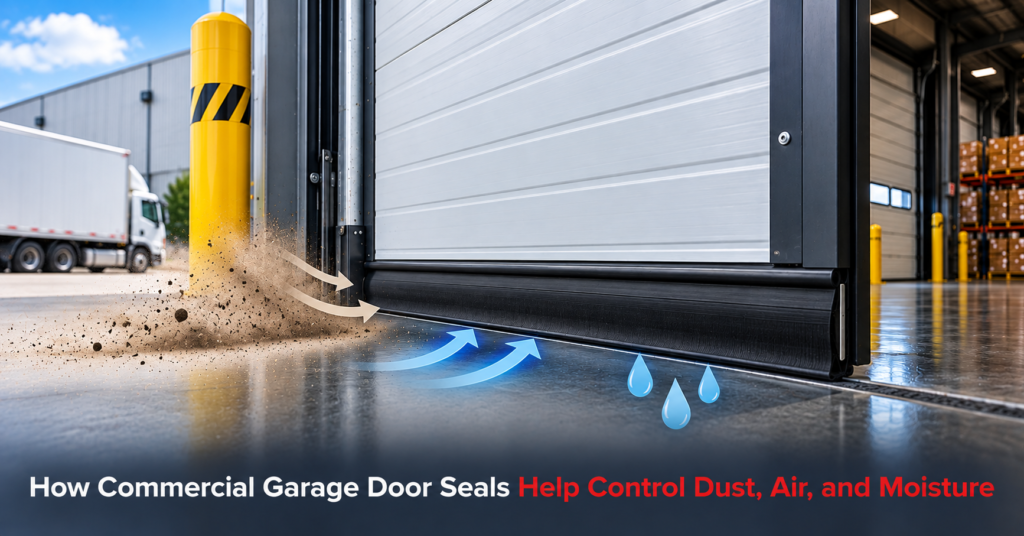
A garage door might look like it’s doing its job just by opening and closing — but a lot happens at the edges that most people never think about. Commercial garage door seals are what keep dust, outside air, and moisture from creeping into a building through the small gaps around the door. At VP Commercial Garage Doors, we regularly see facilities dealing with drafts, dust buildup, or damp floors near the door, and the seals are often the overlooked culprit. This guide explains how seals work, why they matter, and how to know when yours need attention.
What Commercial Garage Door Seals Actually Do
Every commercial garage door has small gaps by design — at the bottom, along the sides, and across the top where the door meets the frame. Seals close those gaps.
There are typically three types of seals on a commercial door:
- Bottom seals, which press against the floor to block drafts, water, and debris
- Side seals (jamb seals), which run along the vertical edges of the door frame
- Top seals (header seals), which close the gap where the door meets the header above it
Together, these seals create a barrier that keeps the building envelope intact, even though the door itself is a moving part.
Why Sealing Matters for Commercial Facilities
Dust and Debris Control
Facilities near loading areas, parking lots, or unpaved surfaces deal with constant dust exposure. Worn or missing seals let that dust drift inside, settling on inventory, equipment, and work surfaces. For warehouses and manufacturing spaces, that’s not just a cleanliness issue — it can affect equipment performance and air quality over time.
Air Infiltration and Energy Efficiency
Gaps around a garage door let conditioned air escape and outside air rush in, which forces HVAC systems to work harder. In a large facility, that inefficiency adds up across every door on the building. Tight, well-maintained seals help keep indoor temperatures more consistent year-round.
Moisture and Water Intrusion
Rain, snowmelt, and humidity are constant challenges for facilities across the Chicago suburbs. Bottom seals in particular are the first line of defense against water pooling at the base of the door. Once a bottom seal cracks or flattens out, water can seep in and lead to floor damage or even rust on nearby components.
Pest Prevention
It’s easy to overlook, but gaps at the bottom of a garage door are a common entry point for rodents and insects. A properly sealed door closes off that access point along with everything else.
Signs Your Garage Door Seals Need Replacing
- Visible daylight showing around the door edges when it’s closed
- A draft you can feel standing near the door on a windy day
- Water or dust visibly collecting along the floor near the threshold
- Cracked, brittle, or flattened rubber on the bottom seal
- Seals that have pulled away or come loose from the track
If any of these sound familiar, it’s usually a quick fix rather than a major repair — but it shouldn’t be ignored, since small gaps tend to get worse over time.
Common Mistakes Facilities Make with Door Seals
- Assuming seals last as long as the door. Seals wear out faster than the door itself, especially bottom seals that deal with constant ground contact.
- Only checking seals when there’s an obvious problem. By the time a leak or draft is noticeable, the seal has often been compromised for a while.
- Using the wrong seal type or size. Not all seals fit every door profile — an improper match won’t create a true seal even if it looks installed correctly.
- Ignoring side and top seals. Most attention goes to the bottom seal, but gaps along the sides and top let in just as much air and dust.
- Skipping seals during a broader maintenance check. Seals are easy to miss during a general commercial garage door repair visit if they’re not specifically inspected.
Expert Tips for Maintaining Effective Seals
- Inspect seals during every seasonal maintenance check, not just when an issue comes up
- Clean debris away from the bottom seal regularly so it can sit flush against the floor
- Replace seals proactively if they’re showing cracking, even if they haven’t failed completely
- Pair seal maintenance with a broader preventive maintenance plan to catch related wear on tracks and panels
- Choose seal materials rated for the temperature swings typical of Illinois winters and summers
Sealing and Facility Type
Different facilities have different sealing priorities. Cold storage and refrigerated warehouses depend heavily on tight seals to maintain internal temperatures. Manufacturing plants with sensitive equipment benefit from strong dust control. Distribution centers with high door-cycle counts need seals that hold up to frequent compression from constant opening and closing.
Matching the seal type to the facility’s specific exposure — dust, moisture, temperature, or all three — makes a real difference in how long the seal performs well.
Why Professional Inspection Helps
Seals can look fine from a distance while still letting in air, dust, or water in smaller amounts that add up over time. A trained technician checks seal compression, alignment, and material condition together, rather than relying on a quick visual glance.
VP Commercial Garage Doors works with businesses in Villa Park, Wood Dale, Addison, and Northbrook to assess seal condition as part of routine facility upkeep, often alongside a broader look at commercial garage door installation needs when a door is nearing the end of its service life.
FAQs
How often should commercial garage door seals be replaced?
It depends on usage and exposure, but seals showing cracking, gaps, or flattening should be replaced as soon as they’re noticed, rather than waiting for a set schedule.
Can worn seals really affect indoor air quality?
Yes. Gaps around the door let outside dust and air infiltrate the space, which can affect both air quality and temperature control inside the building.
Do all commercial garage doors use the same type of seal?
No. Seal type and size vary based on the door’s design and the frame it’s installed in, so matching the right seal to the specific door matters.
Is a drafty garage door always a seal problem?
Not always — misalignment or a damaged track can also cause drafts — but a seal check is usually the first thing worth ruling out.
Can seals help with pest control too?
Yes. A properly sealed bottom edge removes one of the most common entry points for rodents and insects into a facility.
Contact VP Commercial Garage Doors
If your business needs dependable Commercial Garage Door Repair, Commercial Overhead Door Installation, Commercial Garage Door Maintenance, Rolling Steel Door Repair, High-Speed Commercial Doors, Dock Leveler Repair, Loading Dock Equipment Service, or Emergency Commercial Garage Door Repair, trust the experienced team at VP Commercial Garage Doors.
We proudly serve businesses throughout Elk Grove Village, Schaumburg, Naperville, Aurora, Buffalo Grove, Addison, Franklin Park, Palatine, Wheeling, Oak Brook, and surrounding Illinois communities.
Phone: 847 380 6448
Website: VP Commercial Garage Doors
Call VP Commercial Garage Doors today to schedule professional commercial garage door service and keep your warehouse or industrial facility operating safely, efficiently, and without costly interruptions.
Conclusion
Commercial garage door seals do a lot of quiet, essential work — keeping dust out, air where it belongs, and moisture from creeping in. They’re easy to overlook until a draft, a dusty floor, or a damp corner makes the problem obvious. Regular inspection and timely replacement keep a facility’s building envelope intact and reduce strain on HVAC systems, equipment, and inventory alike. When in doubt, a professional check can confirm exactly where a seal is falling short.
Summary
Commercial garage door seals block dust, outside air, and moisture from entering a facility through gaps at the door’s bottom, sides, and top. Worn or damaged seals lead to drafts, dust buildup, and water intrusion, so regular inspection and timely replacement are key to protecting indoor air quality and energy efficiency.