

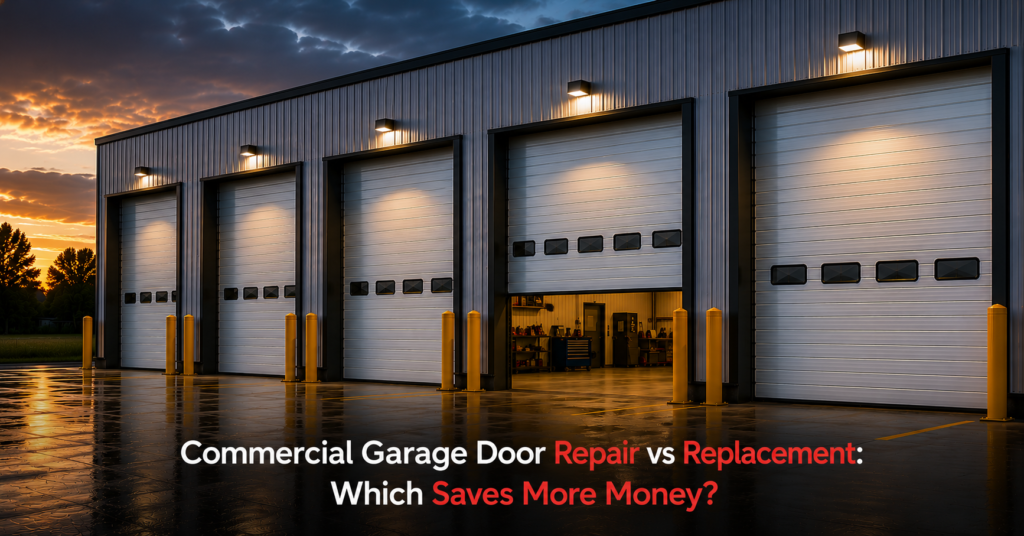
A commercial garage door rarely fails at a convenient time. One morning it’s grinding on the track, the next week it won’t fully close, and suddenly you’re staring at a service call wondering whether it’s worth fixing again — or whether you should just replace the whole thing.
This is one of the most common questions business owners ask, and there’s no one-size-fits-all answer. Sometimes a simple repair solves the problem for years. Other times, that same type of repair is the third one this year, and a new door would have already paid for itself in reliability and reduced downtime.
The good news is that this decision doesn’t have to be a guessing game. There’s a clear, practical way to work through it — looking at age, repair history, safety, and the real impact of downtime — so you can make a decision based on facts, not instinct.
Understanding the Real Question: Value Today vs. Value Over Time
Repair vs. replacement isn’t really about which option is more affordable right now. It’s about which option delivers more value over the next five to ten years.
A repair almost always wins in the short term. But if that door needs another repair a few months later, and another one after that, the “affordable” option quietly becomes the more expensive one over time. Replacement flips that math — a bigger investment today, but often a lower total cost of ownership across the life of the door.
The goal is to compare long-term value, not just the invoice in front of you today.
When Repair Is the Smarter Investment
For most day-to-day issues, repair is the right call — especially if the door is relatively young and the core structure is sound.
Signs a Repair Will Solve the Problem
- Isolated hardware failure. A broken torsion spring, worn rollers, a frayed cable, or a misaligned track are standard, routine fixes.
- Opener or sensor issues. Problems with the motor, circuit board, remote, or safety sensors can almost always be repaired or swapped out without touching the door itself.
- Cosmetic damage. A single dented panel can usually be replaced individually rather than triggering a full door replacement.
- First-time issue on a newer door. If the door is under warranty or has many years of usable life left, a repair extends its lifespan without unnecessary spending.
Why Repair Makes Sense Here
Torsion springs are typically rated for 10,000 to 20,000 cycles, and commercial-grade openers often last 10 to 15 years with proper care. If a door is well within that window and the issue is isolated to one component, repairing it is almost always the smarter path — and it’s the kind of work covered under routine commercial garage door repair rather than a full capital investment.
When Replacement Saves You More in the Long Run
Replacement starts to make more sense once a door crosses certain thresholds — not because the door “looks old,” but because repairing it stops being the better value.
A Simple Guideline: The Halfway Rule
A widely used rule of thumb among commercial door technicians: if a repair is approaching what a comparable portion of a full replacement would cost, replacement is usually the smarter move. A single repair might seem manageable in isolation, but it rarely tells the whole story.
Signs Replacement Is the Better Investment
Repeated service calls. If you’ve called for repairs two or three times in the past year, the door is telling you something. A spring repair this year, an opener fix a few months later, and a cable replacement after that can quietly add up to more than a new door installation would have required — without providing any of the reliability or warranty protection of a new system.
Door age. Commercial doors cycle far more often than residential ones — sometimes hundreds of times a day. That heavy use shortens the practical lifespan of the entire system, even if it was originally built to last decades. Doors approaching or past the two-decade mark often make more sense to replace outright.
Structural damage. Warped panels, rusted-through sections, or a bent frame affect how the door seals and operates. No repair fully corrects a door that has lost its structural integrity.
Obsolete parts. Older commercial doors, especially discontinued models, can be difficult to source parts for. When technicians start special-ordering hardware or improvising fixes, repairs become less reliable and less practical over time.
Outdated safety features. Newer commercial doors come standard with modern auto-reverse systems and photoelectric sensors that meet current UL 325 safety standards. Older doors without these protections carry real liability risk in a commercial setting.
Rising energy costs. Older doors with worn or missing weatherstripping let conditioned air escape. An insulated replacement door can noticeably improve energy efficiency in a warehouse or climate-sensitive facility.
Comparing Repair and Replacement at a Glance
| Factor | Repair | Replacement |
|---|---|---|
| Upfront investment | Lower | Higher |
| Best for | Isolated hardware or opener issues | Structural damage, older doors, repeated failures |
| Downtime | Usually shorter | Can take longer to complete |
| Long-term value | Better for younger doors | Better for doors near end of life |
| Safety and compliance | Depends on existing components | Meets current safety standards |
| Energy efficiency | Typically unchanged | Often improved with better insulation |
The right answer depends heavily on the door’s age, condition, and repair history — which is why a written assessment from a commercial garage door repair technician is always worth getting before deciding either way.
The Hidden Value Factors Business Owners Often Overlook
This is where commercial decisions differ sharply from residential ones. A homeowner’s biggest concern is usually the repair itself. A business has to factor in everything that happens around the repair.
Operational downtime. Every hour a loading dock or bay door is stuck is an hour of blocked shipments, idle staff, or a security gap. For high-traffic facilities, downtime often matters more than the repair itself.
Emergency service timing. Doors rarely fail during business hours on a Tuesday. After-hours or weekend service typically comes with less flexibility than a scheduled visit.
Liability exposure. A malfunctioning safety sensor or a door that doesn’t fully close is a workplace hazard. If an employee or visitor is injured, the impact of that incident far outweighs the value of any repair or replacement decision made to avoid it.
Insurance and compliance. Some commercial policies and local codes require documented, functioning safety systems. An outdated or poorly maintained door can complicate claims or inspections down the line.
A Simple Decision Framework
Before making the call, walk through these questions:
- How old is the door? Relatively young — lean toward repair. Approaching or past two decades — lean toward replacement.
- How many repairs in the past 12–24 months? One or two isolated fixes — repair. Three or more — start exploring replacement.
- Is the damage structural or component-based? Springs, cables, and openers — repair. Warped panels or a bent frame — replacement.
- What would downtime cost if it fails again? High-traffic facilities should weight this heavily in the decision.
- Does it meet current safety standards? If not, replacement closes that gap immediately.
If you’re still unsure, a professional inspection is the fastest way to get clarity. A technician can evaluate the springs, tracks, opener, and panels, and give you a straight answer instead of a guess.
Common Mistakes to Avoid
Fixing the same problem repeatedly without asking why. If a spring or cable keeps failing, something else — like poor door balance or an undersized component — may be the root cause.
Ignoring the opener system. Business owners often focus on the door itself and forget that opener and sensor failures can be just as disruptive.
Choosing a provider based on speed alone without checking experience. Commercial doors are heavier and more complex than residential ones. A provider without commercial-specific experience can misdiagnose the issue, leading to repeat service calls.
Delaying the decision entirely. The longer a business puts off a needed replacement, the more likely it is to face an unplanned breakdown at the worst possible time.
Why Working With a Commercial Specialist Matters
Not every provider is equipped to make this call accurately. At VP Commercial Garage Doors, our technicians work exclusively with commercial-grade doors, openers, and loading dock systems — so the recommendation you get is based on what actually makes sense for your facility, not a one-size-fits-all answer. We provide clear, honest assessments for both repair and replacement, so you can make an informed decision either way.
Areas We Serve
VP Commercial Garage Doors provides commercial garage door repair and replacement services throughout the Chicagoland area, including Naperville, Aurora, Schaumburg, Arlington Heights, Elgin, Skokie, Elmhurst, Des Plaines, Buffalo Grove, Hoffman Estates, Glenview, and Mount Prospect, along with surrounding communities such as Elk Grove Village, Wheaton, Bolingbrook, and Northbrook. Whatever your facility needs — a quick repair or a full commercial door replacement — our technicians can assess the situation and walk you through the most practical path forward.
FAQs About Commercial Garage Door Repair vs. Replacement
How do I know if a repair will actually hold, or if I’ll be back here again in a few months?
A technician can inspect related components — not just the failed part — to catch early wear that might cause the next breakdown. If several parts are near end-of-life, replacement is often the safer bet.
Is it generally more affordable to repair a commercial garage door than replace it?
Usually, yes, for isolated issues. But if a door needs frequent service, or the repair addresses a problem that keeps recurring, replacement often delivers better long-term value.
How long do commercial garage doors typically last?
With regular maintenance, most commercial doors last 15 to 25 years, though heavy-cycle facilities may see components wear out sooner.
Does a new commercial door improve energy efficiency?
Yes. Insulated doors with tight seals reduce drafts and can noticeably improve temperature control compared to an older, worn door.
Can I repair just the opener without replacing the whole door?
In most cases, yes. Opener issues are typically independent of the door panels and track system, and can be repaired or replaced on their own.
Contact VP Commercial Garage Doors
If your warehouse, distribution center, manufacturing facility, or commercial property needs reliable Commercial Garage Door Repair, Emergency Commercial Garage Door Repair, Commercial Overhead Door Installation, Commercial Garage Door Maintenance, Rolling Steel Door Repair, Dock Leveler Repair, or Loading Dock Equipment Service, trust the experienced team at VP Commercial Garage Doors.
We proudly serve businesses throughout Elk Grove Village, Schaumburg, Naperville, Aurora, Buffalo Grove, Addison, Franklin Park, Palatine, Wheeling, Oak Brook, and surrounding Illinois communities.
Phone: 847 380 6448
Website: https://vpcommercialgaragedoors.com/
Contact VP Commercial Garage Doors today to schedule fast, professional commercial garage door service and keep your business operating safely, efficiently, and without costly interruptions.
Final Thoughts
There’s no universal rule that says repair is always the better choice, or replacement is always the smarter investment — it depends on the age of the door, how often it’s failing, and what a breakdown actually costs your business in downtime and disruption. The businesses that make the best decision are the ones that look at the full picture, not just the immediate fix in front of them.
If your commercial garage door has been giving you trouble, get a professional assessment before deciding either way. Sometimes a straightforward repair is all it takes. Other times, replacement is the move that actually delivers more value over the next decade.
Summary
Repairing a commercial garage door is usually more cost-effective for isolated issues like broken springs, cables, or opener problems, especially on newer doors. Replacement delivers better long-term value when repairs keep recurring, the door is aging, or safety features no longer meet current standards.