

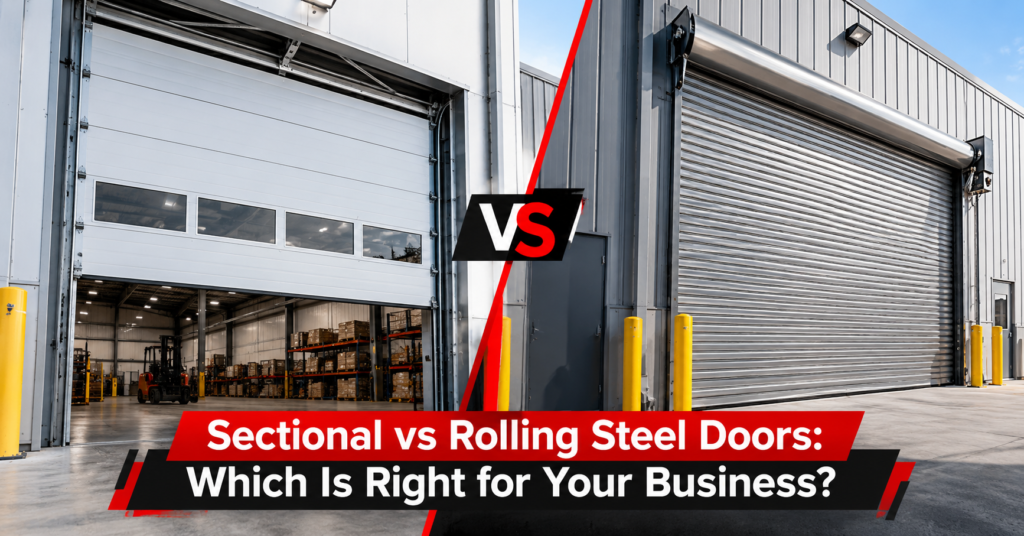
Choosing a commercial garage door isn’t just about size — it’s about how the door actually fits your building, your workflow, and your space constraints. Two of the most common options are sectional doors and rolling steel doors, and they work in very different ways. At VP Commercial Garage Doors, this is one of the first questions we help businesses work through when planning a new installation. This guide breaks down the sectional vs. rolling doors comparison so you can choose the option that actually fits your facility.
Understanding the Two Door Types
What Is a Sectional Door?
A sectional door is made of horizontal panel sections hinged together. As the door opens, it travels up and back along a track, resting flat against the ceiling inside the building. This is the style most people picture when they think of a standard commercial garage door.
What Is a Rolling Steel Door?
A rolling steel door is made of narrow interlocking slats that coil up into a compact drum above the opening as the door rises. Instead of tracking back along the ceiling, the entire door rolls up into itself, taking up very little overhead space.
Key Differences Between Sectional and Rolling Steel Doors
1. Available Space
This is often the deciding factor. Sectional doors need enough horizontal ceiling clearance to track the panels back into the building. Rolling steel doors need much less interior depth since the door coils vertically, making them a better fit for buildings with limited ceiling space or low headroom.
2. Insulation and Energy Efficiency
Sectional doors typically offer better insulation options, since each panel can include a foam core. This makes them a strong choice for climate-controlled spaces, cold storage, or facilities trying to manage heating and cooling costs through the seasons. Rolling steel doors can be insulated too, but sectional doors generally provide more consistent thermal performance.
3. Durability and Security
Rolling steel doors are known for their strength and are often used in high-security applications, such as storage facilities, service stations, and areas prone to break-in attempts. The slat design resists forced entry well. Sectional doors are also durable, but their panel construction isn’t typically built for the same level of security as solid rolling steel.
4. Appearance and Facility Use
Sectional doors tend to have a more finished, traditional look, which fits well for retail-facing entrances, service bays, or any area where appearance matters. Rolling steel doors have a more industrial look and are commonly used for warehouses, loading docks, and back-of-house openings where function matters more than aesthetics.
5. Maintenance Needs
Both door types require regular upkeep, but the components differ. Sectional doors rely on springs, cables, rollers, and hinges across each panel. Rolling steel doors depend on the coil mechanism and guide tracks along the sides. A commercial garage door inspection should account for these differences, since the wear points aren’t the same.
6. Operating Speed
Rolling steel doors often open and close faster due to their compact coiling motion, which can be an advantage for high-traffic docks where speed matters. Sectional doors typically move a bit slower since the panels travel a longer path along the track.
Which Door Is Right for Your Business?
Choose a Sectional Door If:
- You have adequate ceiling clearance for the tracking system
- Insulation and temperature control are a priority
- You want a more polished, finished appearance
- The door is used at a moderate frequency rather than constant cycling
Choose a Rolling Steel Door If:
- Overhead space is limited
- Security is a top priority for the opening
- The door needs to handle high-frequency use or fast cycling
- The space is industrial or warehouse-focused rather than customer-facing
Common Mistakes Businesses Make When Choosing
- Not measuring ceiling clearance first. Choosing a sectional door without confirming enough tracking space can lead to installation problems later.
- Overlooking security needs. A standard sectional door may not provide the same resistance to forced entry as rolling steel in higher-risk areas.
- Ignoring insulation requirements. Facilities with climate-sensitive operations can run into energy issues if the wrong door type is chosen.
- Choosing based on appearance alone. A door that looks right but doesn’t match operational needs can create ongoing frustration.
- Skipping a professional site assessment. Ceiling height, usage frequency, and security needs all affect which door actually works best.
Expert Tips for Making the Right Choice
- Measure available ceiling and side-room space before deciding between door types
- Factor in how often the door will cycle each day, not just its intended use
- Ask about insulation ratings if the space behind the door is climate-controlled
- Consider long-term commercial garage door maintenance needs for each option, not just the upfront installation
- If security is a concern, prioritize rolling steel or reinforced sectional options
- Get a professional opinion if your facility has unusual space constraints or mixed-use needs
Why a Professional Assessment Matters
The right door depends on the specific building — its ceiling height, usage pattern, security requirements, and climate needs all play a role. VP Commercial Garage Doors works with businesses in Elk Grove Village, Deerfield, Glendale Heights, and Prospect Heights to evaluate these factors before recommending sectional or rolling steel options. This assessment is often paired with a full look at commercial garage door installation timelines and requirements, so the final choice fits both the space and the budget-free priorities of the business.
FAQs
Which door type is better for a loading dock?
Rolling steel doors are often preferred for loading docks due to their speed and space efficiency, though sectional doors can also work well depending on ceiling clearance.
Are rolling steel doors more secure than sectional doors?
Generally, yes. Their slat construction is built to resist forced entry, making them a common choice for higher-security applications.
Can sectional doors be used in warehouses?
Yes, especially when there’s enough ceiling space and insulation is a priority, such as in temperature-controlled storage areas.
Do rolling steel doors require more maintenance than sectional doors?
Not necessarily more, but the maintenance focus is different — rolling steel relies on the coil and guide system, while sectional doors depend on panel hardware like springs and rollers.
How do I know which door fits my building?
A professional site evaluation is the most reliable way to confirm ceiling clearance, security needs, and usage patterns before choosing.
Contact VP Commercial Garage Doors
If your business needs dependable Commercial Garage Door Repair, Commercial Overhead Door Installation, Commercial Garage Door Maintenance, Rolling Steel Door Repair, High-Speed Commercial Doors, Dock Leveler Repair, Loading Dock Equipment Service, or Emergency Commercial Garage Door Repair, trust the experienced team at VP Commercial Garage Doors.
We proudly serve businesses throughout Elk Grove Village, Schaumburg, Naperville, Aurora, Buffalo Grove, Addison, Franklin Park, Palatine, Wheeling, Oak Brook, and surrounding Illinois communities.
Phone: 847 380 6448
Website: VP Commercial Garage Doors
Call VP Commercial Garage Doors today to schedule professional commercial garage door service and keep your warehouse or industrial facility operating safely, efficiently, and without costly interruptions.
Conclusion
Sectional and rolling steel doors each bring real advantages, but they serve different needs. Sectional doors offer strong insulation and a more finished look, while rolling steel doors excel in tight spaces, high-security settings, and fast-paced loading areas. The right choice comes down to your building’s layout, how the door will be used, and what matters most for your operations. A professional assessment can help confirm the best fit before installation begins.
Summary
Sectional doors offer better insulation and a finished appearance, making them ideal for climate-controlled spaces with adequate ceiling clearance. Rolling steel doors save overhead space, operate faster, and provide stronger security, making them well suited for warehouses and high-traffic loading docks. The right choice depends on space, security needs, and usage frequency.