

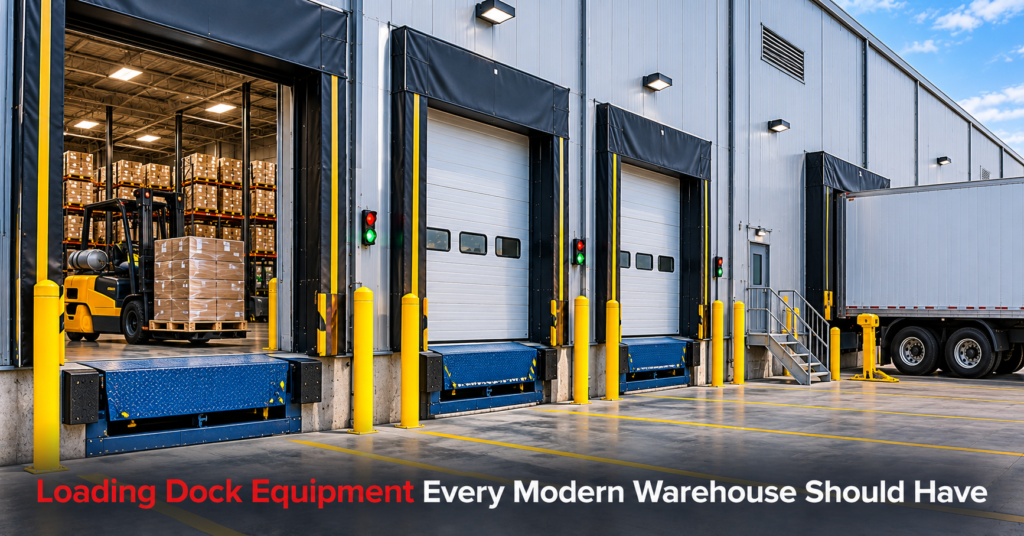
Loading dock equipment is what actually makes a warehouse function day-to-day. It’s easy to focus on racking systems, forklifts, and inventory software when thinking about warehouse efficiency, but the dock itself — with its own specific set of equipment — is where nearly every shipment starts and ends its journey through the facility.
At VP Commercial Garage Doors, we work with warehouses across a wide range of setups, and the ones that run smoothly almost always have the same core equipment in place, properly maintained and working together. This guide covers exactly what belongs on that list, and why each piece matters.
Why the Right Equipment Mix Matters More Than People Expect
A loading dock is one of the busiest, highest-risk areas in any warehouse, and missing or outdated equipment tends to show up as slower turnaround, more frequent near-misses, and inconsistent daily operations. The right combination of equipment doesn’t just make the dock safer — it directly affects how quickly and reliably goods move through the entire facility.
Dock Levelers
Dock levelers bridge the gap between the trailer bed and the dock floor, and they come in a few different forms — mechanical, hydraulic, and air-powered — each suited to different facility needs. Because they support the weight of forklifts and loaded pallets crossing them constantly, levelers experience significant daily wear and need to be properly matched to a facility’s typical trailer traffic.
Vehicle Restraints and Wheel Chocks
Vehicle restraints secure a trailer to the dock during loading and unloading, addressing one of the most serious hazards at any dock: a trailer creeping or pulling away while work is still underway. Restraint systems that connect directly to a trailer’s rear impact guard offer stronger protection than wheel chocks alone, though many facilities use both as a layered safety approach.
Dock Seals and Shelters
Seals and shelters close the gap around a parked trailer, protecting the building’s interior climate and keeping outside weather from affecting the dock area. Worn or damaged seals let in drafts, moisture, and debris, which can create both energy inefficiency and slippery surface hazards near the dock.
Dock Bumpers
Bumpers absorb the impact of a trailer docking, protecting both the building structure and the trailer itself from repeated contact damage. Like most dock equipment, bumpers wear down over time and should be inspected regularly, since damaged or missing bumpers increase the risk of structural damage during routine docking.
Dock Lights and Communication Signals
Proper lighting at the dock supports both safety and efficiency, helping workers spot hazards and drivers navigate accurately, especially during early morning or evening shifts. Communication signals — typically red and green light systems — coordinate drivers and dock staff, removing the ambiguity that leads to premature departures and other avoidable delays.
Dock Ramps and Plates
Ramps and plates create a smooth, safe transition point for forklifts, pallet jacks, and carts moving between the dock and trailer, reducing the risk of dropped loads or tipping hazards during transfer. These are especially useful for facilities handling a variety of trailer heights and configurations.
Dock Gates and Fall Protection Barriers
Open dock doors create a real fall hazard, especially when a trailer hasn’t yet arrived or has already departed. Dock gates and physical barriers protect workers and equipment from accidentally stepping or driving off an open edge, addressing one of the most common and preventable categories of loading dock injury.
Dock Lifts
For facilities handling a range of trailer heights or specialized loading needs, dock lifts provide adjustable-height loading and unloading capability that a fixed leveler can’t accommodate on its own. They’re particularly useful in operations with varied fleet types or non-standard vehicle heights.
Seasonal Equipment for Weather Extremes
A well-equipped dock also accounts for seasonal conditions, especially in a climate with real winter extremes. Snow and ice removal tools, along with proper drainage near dock doors, prevent weather-related slip hazards and equipment issues that tend to spike during the coldest months of the year.
Why Equipment Should Work Together, Not in Isolation
One of the most effective safety practices in modern dock design is interlocking equipment so it operates in a specific, enforced sequence rather than relying on staff to remember the right order. In a properly interlocked system, the vehicle restraint must engage before the door can open, the door must be fully open before the leveler becomes operational, and the sequence reverses in the correct order before departure. This kind of sequencing removes room for human error and significantly reduces the chances of equipment being used out of order.
A Quick Essential Equipment Checklist
- Dock levelers matched to your facility’s typical trailer traffic
- Vehicle restraints, ideally paired with wheel chocks as a backup
- Dock seals or shelters in good condition, without visible cracking or gaps
- Bumpers inspected regularly for wear or damage
- Adequate lighting and a clear communication signal system
- Ramps or plates for smooth equipment transitions where needed
- Dock gates or barriers protecting open edges
- Dock lifts for facilities handling varied trailer heights
- Seasonal tools ready ahead of winter weather
Where We Help Warehouses Equip Their Loading Docks
We work with facilities throughout the Chicagoland area, including Bartlett, Carol Stream, Roselle, and Bloomingdale, along with many surrounding communities. Wherever your warehouse is located, our team can help you evaluate your current dock equipment and identify what your facility actually needs.
FAQs About Essential Loading Dock Equipment
What’s the single most important piece of loading dock equipment?
It depends on the facility, but dock levelers and vehicle restraints are generally considered the two most critical pieces, since they directly address the highest-risk parts of the loading process.
Do small warehouses need the same equipment as large distribution centers?
The core categories — levelers, restraints, seals, and lighting — are important regardless of facility size, though the scale and specific type of equipment should match actual usage levels.
Why does equipment sequencing matter if all the pieces are already in place?
Even well-maintained equipment can be used incorrectly if staff skip steps. Interlocked sequencing removes that risk by enforcing the correct order automatically.
How often should dock equipment be inspected?
Regularly, with high-wear items like levelers, restraints, and bumpers checked most frequently, since they handle the most daily mechanical stress.
Is seasonal equipment really necessary, or just a nice-to-have?
For facilities in climates with real winter extremes, seasonal tools like snow and ice removal equipment are an important part of preventing weather-related hazards near the dock.
Contact VP Commercial Garage Doors
If your business needs dependable Commercial Garage Door Repair, Commercial Overhead Door Installation, Commercial Garage Door Maintenance, Rolling Steel Door Repair, High-Speed Commercial Doors, Dock Leveler Repair, Loading Dock Equipment Service, or Emergency Commercial Garage Door Repair, trust the experienced team at VP Commercial Garage Doors.
We proudly serve businesses throughout Elk Grove Village, Schaumburg, Naperville, Aurora, Buffalo Grove, Addison, Franklin Park, Palatine, Wheeling, Oak Brook, and surrounding Illinois communities.
Phone: 847 380 6448
Website: VP Commercial Garage Doors
Call VP Commercial Garage Doors today to schedule professional commercial garage door service and keep your warehouse or industrial facility operating safely, efficiently, and without costly interruptions.
Final Thoughts
A well-equipped loading dock isn’t the result of any single piece of equipment — it’s the combination of levelers, restraints, seals, lighting, and safety barriers all working together as a coordinated system. Warehouses that keep this full picture in mind, rather than focusing on just one or two components, tend to run safer and more predictably than those with gaps in their setup.
If it’s been a while since your facility’s dock equipment was fully evaluated, that’s the best place to start closing any gaps.
Summary
Loading dock equipment every modern warehouse should have includes dock levelers, vehicle restraints, seals and shelters, bumpers, lighting and communication signals, ramps or plates, fall protection barriers, and dock lifts. Interlocking this equipment to operate in the correct sequence further improves safety and daily efficiency.