

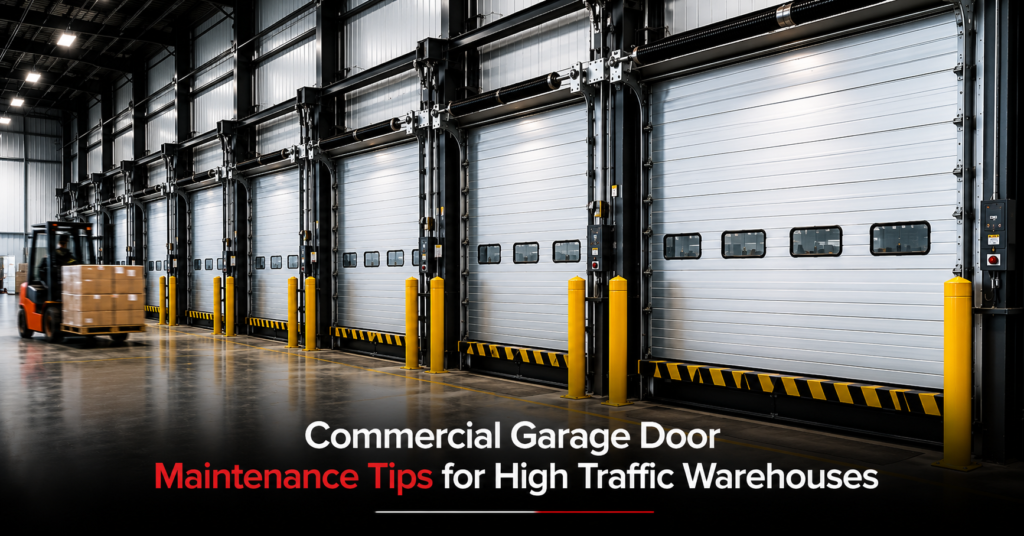
Not all commercial garage doors live the same life. A door on a low-traffic storage building might open a handful of times a day. A door on a busy warehouse loading dock can cycle dozens or even hundreds of times before lunch. That difference matters more than most facilities realize, because a maintenance routine built for occasional use simply can’t keep up with a door that never stops moving.
At VP Commercial Garage Doors, high-traffic warehouses are some of the most common facilities we work with, and the pattern is consistent: doors that fail early almost always wore out faster than expected because they were maintained on a schedule that didn’t match how hard they were actually working. This guide covers what high-traffic facilities need to do differently to keep their doors running reliably.
Why High-Traffic Warehouses Need a Different Maintenance Approach
Most wear on a garage door happens per cycle, not per month. A door that opens and closes constantly accumulates that wear far faster than a generic maintenance calendar accounts for. Springs fatigue from repeated winding and unwinding, rollers and bearings wear down with every pass, and hardware loosens from constant vibration. A schedule designed around “twice a year” simply doesn’t reflect the reality of a door that’s cycling all day, every day.
Understanding Cycle-Based Maintenance vs. Calendar-Based Maintenance
Calendar-based maintenance checks a door on a fixed schedule regardless of how much it’s actually being used. Cycle-based maintenance ties service frequency to how often the door operates, which is a far more accurate way to protect a high-traffic system. In practice, this usually means low-traffic doors can go longer between service visits, while busy loading docks and fleet bays benefit from commercial garage door maintenance visits scheduled monthly or quarterly instead of just once or twice a year.
The Hidden Enemy: Warehouse Dust and Debris
Warehouse floors generate a constant stream of particulate — pallet splinters, cardboard fiber, concrete dust kicked up by forklift traffic — and airflow from open bays keeps it circulating. That grit settles directly on tracks and rollers, where it mixes with lubricant and behaves almost like sandpaper, grinding into contact points instead of protecting them.
This is one of the most overlooked differences between a warehouse door and a door in a cleaner environment. A greased track in a dust-heavy warehouse needs far more frequent attention than the same setup in a low-debris facility, simply because it’s collecting abrasive material every single day.
Upgrading to Components Built for High Cycles
High-Cycle Springs
Standard torsion springs aren’t always matched to the demands of constant use. High-cycle springs are built specifically to handle frequent winding and unwinding, and upgrading to them is one of the most effective ways to reduce unexpected spring failures on a busy door.
Nylon or Resin Rollers
Steel rollers hold up well under heavy use but require regular greasing to stay quiet and smooth. Nylon or resin rollers run quieter and don’t need the same lubrication, which makes them a strong option for high-cycle doors, especially in facilities where noise is a factor.
Heavy-Duty Hinges and Tracks
Standard hardware wears faster under constant cycling. Facilities with high daily door use benefit from heavier-duty hinges and reinforced tracks designed to handle that level of demand without loosening or deforming as quickly.
What Staff Can Handle Monthly
- Wipe down track faces to remove dust and debris buildup
- Clean sensor lenses and reflectors so photo-eye safety features stay accurate
- Clear debris from the floor where the bottom seal makes contact
- Apply light lubricant to hinge pins and bearing plates
- Listen for new noises or changes in how the door sounds during operation
- Track approximate daily cycle counts to spot unusual increases in use
What Requires a Professional Technician
Torsion springs, lift cables, drums, and the shaft they’re mounted on store significant energy, and they remain dangerous even when the door is sitting closed. Adjusting spring tension, replacing cables, or servicing the counterbalance system should always be handled by a trained technician — this isn’t a task for general maintenance staff, regardless of experience with other parts of the facility.
Matching Maintenance Frequency to Traffic Volume
Not every day looks the same for a busy warehouse. Facilities that see seasonal spikes — holiday shipping volume, for example — put significantly more strain on their doors during those periods than during slower months. It’s worth increasing inspection frequency heading into a facility’s busiest season rather than waiting to discover a worn component at the worst possible time. A preventive maintenance plan that flexes with actual usage patterns protects the door far more effectively than a fixed schedule that ignores seasonal demand.
Warning Signs Specific to High-Traffic Doors
- Noisy or jerky movement that wasn’t there before
- Noticeably slower opening and closing times
- The door overshooting its stopping point or failing to close fully
- Misaligned panels or a door that looks like it’s sagging on one side
- Visible wear on cables, pulleys, or rollers
Any of these signs on a high-cycle door should be treated as urgent, since components under this much daily stress tend to fail quickly once they start showing damage. This ties directly into door balance, since many of these symptoms trace back to uneven weight distribution across a heavily used system.
Building a Service Log That Actually Helps
A detailed maintenance log matters even more for high-traffic doors than for occasional-use ones, since it’s the clearest way to track wear patterns over time. At minimum, a useful log should note the date of each check, approximate cycle activity since the last visit, any components showing wear, and what was done about it. Over time, this record makes it much easier to anticipate when a component is approaching the end of its useful life instead of being caught off guard.
Why Working With a Commercial Specialist Matters
High-traffic doors need more than a generic maintenance plan — they need a routine built around how hard the door is actually working. VP Commercial Garage Doors helps warehouses design maintenance schedules based on real usage patterns, not a one-size-fits-all calendar, so components get attention before constant cycling turns into an unplanned downtime event.
Where We Help High-Traffic Warehouses Stay Running
We work with facilities throughout the Chicagoland area, including Carpentersville, Cary, Schiller Park, and Bridgeview, along with many surrounding communities. Wherever your warehouse is located, our team can help you build a maintenance plan that actually matches your daily door traffic.
FAQs About Maintenance for High-Traffic Warehouse Doors
How often should a high-traffic warehouse door be inspected compared to a standard commercial door?
High-traffic doors generally need more frequent inspections — often monthly or quarterly — compared to lower-use doors that may only need service once or twice a year.
Are high-cycle springs worth upgrading to for a busy loading dock?
Yes. High-cycle springs are built specifically to handle frequent use and tend to hold up significantly better than standard springs on doors that cycle constantly.
Can warehouse staff safely lubricate and inspect doors themselves?
Basic tasks like cleaning tracks, wiping sensors, and applying light lubricant to hinges and bearings can be handled by trained staff. Springs, cables, and the counterbalance system should always go to a professional.
Why does warehouse dust affect garage doors more than in other settings?
Warehouse floors generate constant particulate from pallets, packaging, and forklift traffic, and that debris mixes with track lubricant in a way that accelerates wear if not cleaned regularly.
Should maintenance frequency change during a facility’s busiest season?
Yes. Increasing inspection frequency ahead of a high-volume season helps catch wear before it turns into a failure during the period when the door is needed most.
Contact VP Commercial Garage Doors
If your business needs dependable Commercial Garage Door Repair, Commercial Overhead Door Installation, Commercial Garage Door Maintenance, Rolling Steel Door Repair, High-Speed Commercial Doors, Dock Leveler Repair, Loading Dock Equipment Service, or Emergency Commercial Garage Door Repair, trust the experienced team at VP Commercial Garage Doors.
We proudly serve businesses throughout Elk Grove Village, Schaumburg, Naperville, Aurora, Buffalo Grove, Addison, Franklin Park, Palatine, Wheeling, Oak Brook, and surrounding Illinois communities.
Phone: 847 380 6448
Website: https://vpcommercialgaragedoors.com/
Call VP Commercial Garage Doors today to schedule professional commercial garage door service and keep your warehouse or industrial facility operating safely, efficiently, and without costly interruptions.
Final Thoughts
A high-traffic warehouse door works harder every single day than most maintenance schedules assume. Recognizing that difference — and adjusting inspection frequency, component choices, and daily habits accordingly — is what separates a door that lasts from one that fails well before it should.
If your facility’s door maintenance routine hasn’t changed since the day it was installed, it’s worth reevaluating whether that routine still matches how much the door is actually being used today.
Summary
Commercial garage door maintenance for high-traffic warehouses requires cycle-based scheduling rather than a fixed calendar, since constant use accelerates wear on springs, rollers, and hardware. Upgrading to high-cycle springs, cleaning debris regularly, and increasing inspection frequency during peak seasons all help prevent premature failure.