

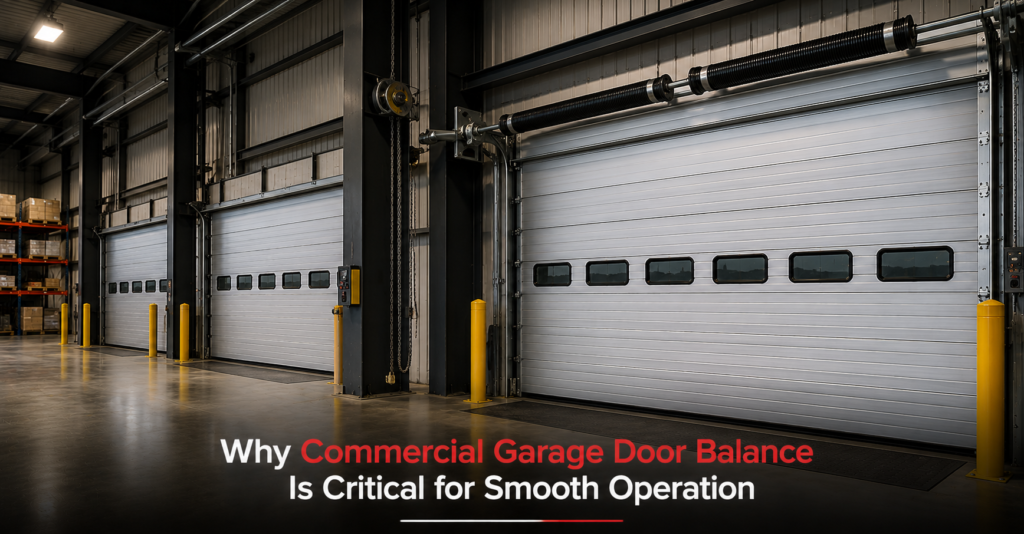
Most people never think about garage door balance until something goes wrong — a door that suddenly feels heavier than usual, a strange noise on the way down, or worse, a door that won’t stay open on its own. For a commercial facility, where doors are larger, heavier, and cycling constantly throughout the day, balance isn’t a minor technical detail. It’s one of the most important factors in how safely and smoothly the entire system operates.
At VP Commercial Garage Doors, balance is one of the first things our technicians check during any service call, because so many other problems trace back to it. This guide breaks down what door balance actually means, why it matters so much in a commercial setting, and how to recognize the signs before a small imbalance turns into a bigger problem.
What “Door Balance” Actually Means
A garage door doesn’t lift itself — it’s counterbalanced by springs that carry most of the door’s weight, so the opener only has to manage the rest. When a door is properly balanced, that weight is distributed evenly across the spring system, allowing the door to move smoothly and stay in place at any point along the track.
When something disrupts that balance — worn springs, uneven cable tension, a shifted track — the door stops moving the way it was designed to. Instead of gliding evenly, it starts fighting against itself.
Why Balance Matters More in a Commercial Setting
Commercial doors are larger, heavier, and cycle far more often than residential ones. That means an imbalance issue develops faster and creates more strain, more often, than it would on a smaller door. It also means the consequences are bigger: a commercial door out of balance isn’t just inconvenient, it’s a real safety hazard around employees, forklifts, and vehicles that are constantly moving through the same space.
Because commercial doors rely on commercial garage door repair specialists who understand higher-tension spring systems and heavier-duty hardware, balance issues on these doors typically require a different level of expertise than a standard residential adjustment.
Signs Your Commercial Door Is Out of Balance
Visual and Movement Signs
A door that looks crooked or uneven while opening or closing is one of the clearest indicators of a balance problem. You might also notice the door drifting upward or downward on its own after being manually lifted partway, or moving noticeably slower than it used to.
Sound and Sensation Signs
Grinding, squeaking, or banging noises during operation often point to mechanical stress caused by uneven weight distribution. If the door feels unusually heavy when operated manually, or the opener seems to be working harder than normal, balance is a likely culprit.
Sealing and Energy Signs
An unbalanced door may not close evenly against the floor or frame, leaving small gaps on one side. Those gaps let in drafts, dust, and moisture, which affects both energy efficiency and the interior environment near the dock — something to watch for as part of routine preventive maintenance.
What Causes a Commercial Door to Fall Out of Balance
Several factors can throw a commercial door out of balance over time:
- Uneven or degraded spring tension from constant use
- A cable that has stretched, frayed, or shifted on one side
- Tracks that have bent, shifted, or gathered debris
- Impact damage from a forklift, vehicle, or heavy equipment
- Temperature swings that affect spring performance, especially during harsh winters
- Additional weight added to the door after installation, such as mounted equipment
Any one of these on its own can be enough to disrupt balance. In a high-cycle commercial environment, several of these factors are often at play at once.
The Ripple Effect: What Happens When Imbalance Goes Unaddressed
Strain on the Opener
An unbalanced door forces the opener motor to compensate for weight it wasn’t designed to carry alone. Over time, that added strain wears down gears, belts, and chains faster than normal use would.
Accelerated Wear on Springs, Cables, and Rollers
Balance issues rarely stay isolated to one component. Uneven stress spreads to the springs, cables, and rollers, accelerating wear across the entire system and increasing the chances of a sudden failure.
Safety Risk
This is the most serious consequence. A door that’s significantly out of balance can drop unexpectedly, especially if it’s being operated manually or if a spring gives out completely. Given how often commercial doors operate near people and equipment, this risk shouldn’t be underestimated.
Energy Loss
A door that doesn’t seal evenly allows conditioned air to escape every time it’s closed, which adds up in a facility relying on climate control for comfort or product protection.
How Door Balance Is Tested
A basic balance check involves disconnecting the opener and manually operating the door. When lifted about halfway, a properly balanced door should stay in place on its own, moving with minimal resistance. If it drifts upward, falls downward, or feels noticeably heavy, the door is out of balance.
This test should always be performed with caution, and never by someone unfamiliar with the door’s spring system. Commercial doors carry significant tension, and an already-compromised spring can behave unpredictably during testing.
Why Balance Adjustments Should Always Be Left to a Professional
Diagnosing an imbalance is one thing — correcting it is another. Adjusting spring tension on a commercial door involves working directly with components under extreme force, and doing it incorrectly can cause serious injury or make the imbalance worse. This is not a task for general maintenance staff, regardless of how straightforward it might look.
A trained technician can safely adjust tension, inspect for related wear on cables and tracks, and confirm the entire system is working together correctly — not just the specific symptom that prompted the call.
Keeping Your Door Balanced Over Time
- Include a balance check as part of routine commercial garage door maintenance, not just when something feels off
- Address unusual noises or movement right away instead of waiting
- Keep tracks clear of debris and check for visible damage after any impact
- Avoid adding weight or equipment to the door without professional guidance
- Schedule a professional safety inspection that includes balance testing, especially before extreme seasonal weather
Why Working With a Commercial Specialist Matters
Balance issues are easy to overlook until they cause a bigger problem, which is why they deserve a closer look during every service visit. VP Commercial Garage Doors evaluates balance as a standard part of every inspection and repair, so smaller issues get caught before they turn into strain on the opener, premature wear, or a safety incident.
Where We Help Businesses Keep Their Doors Balanced and Safe
We work with facilities throughout the Chicagoland area, including Algonquin, Crystal Lake, Woodstock, and Huntley, along with many surrounding communities. Wherever your facility is located, our team can test your door’s balance and correct any issues safely and thoroughly.
FAQs About Commercial Garage Door Balance
How often should a commercial door’s balance be checked?
Balance should be checked as part of routine maintenance visits, along with an additional check any time unusual noise, movement, or resistance is noticed.
Is it safe for facility staff to test door balance themselves?
A basic visual and movement check can be done carefully, but any adjustment to spring tension should always be left to a trained technician due to the risk involved.
Can an unbalanced door really damage the opener?
Yes. The opener has to work harder to compensate for uneven weight, which accelerates wear on its internal components over time.
What’s the most dangerous sign of an unbalanced door?
A door that drifts or drops unexpectedly when partially open is the clearest warning sign of a serious balance problem and should be addressed immediately.
Does door balance affect energy efficiency?
Yes. An unbalanced door often doesn’t seal evenly, which allows drafts and temperature loss around the opening.
Contact VP Commercial Garage Doors
If your business needs dependable Commercial Garage Door Repair, Commercial Overhead Door Installation, Commercial Garage Door Maintenance, Rolling Steel Door Repair, High-Speed Commercial Doors, Dock Leveler Repair, Loading Dock Equipment Service, or Emergency Commercial Garage Door Repair, trust the experienced team at VP Commercial Garage Doors.
We proudly serve businesses throughout Elk Grove Village, Schaumburg, Naperville, Aurora, Buffalo Grove, Addison, Franklin Park, Palatine, Wheeling, Oak Brook, and surrounding Illinois communities.
Phone: 847 380 6448
Website: https://vpcommercialgaragedoors.com/
Call VP Commercial Garage Doors today to schedule professional commercial garage door service and keep your warehouse or industrial facility operating safely, efficiently, and without costly interruptions.
Final Thoughts
Door balance might not be the most visible part of a commercial garage door system, but it affects nearly everything else — how smoothly the door operates, how long its components last, and how safely it performs around the people working near it every day. Catching an imbalance early is one of the simplest ways to protect the rest of the system from unnecessary wear and risk.
If your commercial door has felt off lately — heavier, noisier, or less predictable than usual — it’s worth having the balance checked before it becomes a bigger issue.
Summary
Commercial garage door balance refers to how evenly the door’s weight is distributed by its spring system. Proper balance ensures smooth operation, reduces strain on the opener, and prevents safety hazards. Warning signs include uneven movement, unusual noise, and a door that won’t hold its position, and adjustments should always be handled by a trained technician.