

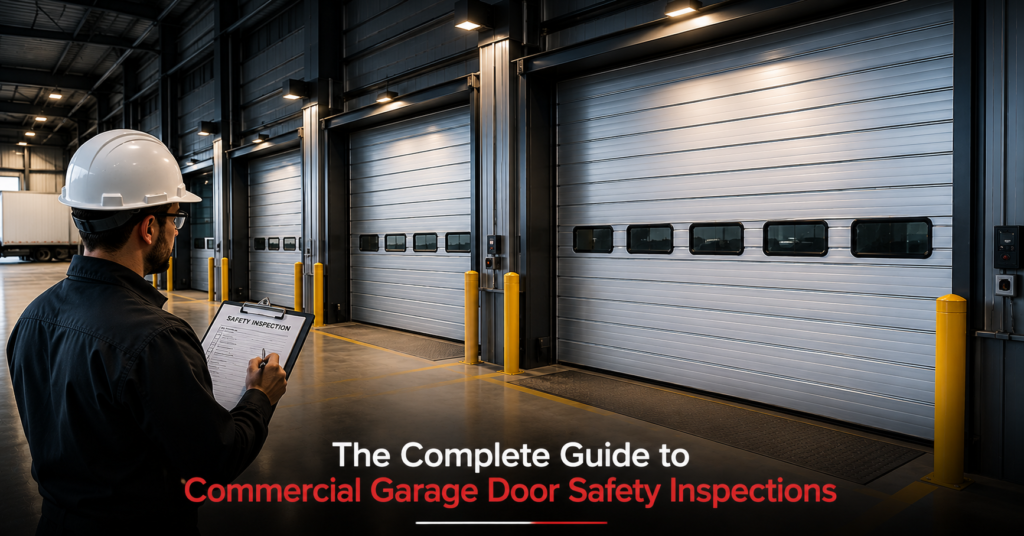
A commercial garage door is one of the largest moving mechanical systems in any facility, and it operates around people, forklifts, and vehicles all day, every day. Most of the time, that’s exactly what it’s designed to handle. But when a safety inspection gets skipped or rushed, small issues have a way of turning into serious hazards — often without much warning.
At VP Commercial Garage Doors, safety inspections are the foundation of everything else we do for a facility. This guide walks through exactly what a complete commercial garage door safety inspection should cover, how often each check should happen, and where the line is between what staff can safely handle and what belongs to a trained technician.
Why Safety Inspections Matter for Commercial Doors
Consumer safety data links garage door injuries to tens of thousands of emergency room visits every year in the United States, and commercial facilities carry added risk compared to residential settings. Commercial doors are larger, heavier, cycle far more frequently, and operate in constant proximity to forklifts, pallet jacks, and vehicle traffic.
Most serious incidents share a pattern: a component that was already showing signs of wear before it failed. Regular, structured safety inspections are what catch that warning sign in time — before it becomes an injury, a damaged shipment, or an unplanned shutdown.
How Commercial Doors Differ From Residential Ones
It’s tempting to assume garage door safety works the same way regardless of setting, but commercial systems are built and used differently. They typically feature larger panels, higher-cycle springs rated for frequent use, and chain-driven or jackshaft openers rather than standard residential-style units. They also operate under stricter safety expectations, simply because the consequences of a failure are more serious in a workplace with constant foot and vehicle traffic. A commercial safety inspection needs to account for all of this — it isn’t just a scaled-up version of a residential checklist.
The Complete Inspection Checklist, By Frequency
A structured inspection routine breaks naturally into daily, weekly, monthly, quarterly, and annual tasks, each covering a different depth of the system.
Daily Checks
- Confirm the area around the door is clear of obstructions before operation
- Watch for full, smooth travel from fully open to fully closed
- Note any unusual noise, hesitation, or resistance during operation
Weekly Checks
- Visually inspect panels for dents, cracks, or separated seams
- Check tracks for visible misalignment or debris buildup
- Look over cables and hardware for obvious fraying, rust, or looseness
- Confirm weatherstripping and seals are intact, without gaps or brittleness
Monthly Checks
- Test door balance by disconnecting the opener and manually lifting the door partway; it should hold its position
- Test the auto-reverse feature by placing an object in the door’s path while closing
- Confirm photo-eye sensors are aligned and free of dirt or obstruction
- Lubricate rollers, hinges, and springs with an appropriate commercial-grade product
- Tighten any hardware that’s worked loose from regular vibration
Quarterly Checks
- Inspect the opener’s force settings to confirm they’re properly calibrated
- Test the emergency release and manual hoist mechanism, if equipped
- Review posted safety labels and operating instructions for visibility and accuracy
- Check battery backup systems, if the facility relies on them
Annual Professional Inspection
- Full evaluation of spring tension, cable condition, and structural integrity
- Detailed opener inspection, including belts, chains, and control systems
- Verification against applicable safety and code requirements
- Documented findings and recommendations for any needed repairs
Key Safety Systems to Never Overlook
Auto-Reverse and Photo-Eye Sensors
This system is designed to stop and reverse the door the instant it detects an obstruction. It should be tested regularly using a simple method: place a solid object in the door’s path while it’s closing. If the door doesn’t reverse immediately, it needs professional attention right away — this isn’t a feature to leave unchecked.
Emergency Release and Manual Hoist
If a door needs to be opened manually during a power outage or opener failure, the emergency release mechanism needs to work smoothly. A stuck or seized release is a serious safety concern, and every relevant employee should know exactly where it is and how to use it.
Springs and Cables — Never DIY
Torsion springs and cables operate under extreme tension and are responsible for most serious commercial garage door injuries when they fail. These components should never be adjusted or repaired by untrained staff. Leave spring and cable work entirely to a trained technician with the right tools and experience.
Force Settings and Close Pressure
If a door’s closing force is set too high, it can fail to reverse properly when it meets resistance, turning a minor obstruction into a real hazard. Force settings should be checked and calibrated as part of routine professional maintenance.
Compliance Standards to Know
Commercial garage doors are generally expected to align with recognized industry safety guidelines, including standards referenced by organizations like ANSI, UL, and DASMA, along with general workplace safety expectations under OSHA. These guidelines cover everything from safety sensor requirements to proper signage and labeling. A qualified commercial technician can help confirm your equipment and documentation align with the standards relevant to your facility and location.
Documentation: Why a Maintenance Log Matters for Compliance
A written record of every inspection, test, and repair does more than keep your team organized — it demonstrates due diligence. If an incident or safety audit ever occurs, a documented inspection history shows that your facility has been proactive about safety rather than reactive. At minimum, a maintenance log should track the date of each inspection, what was checked, any issues found, and what corrective action was taken.
When to Call a Professional vs. What Staff Can Handle
Daily and weekly checks — visual inspections, clearing the area, noting unusual sounds — are well within the ability of trained on-site staff. Monthly safety feature testing, like auto-reverse checks and lubrication, can often be handled internally as well, provided staff have been shown the correct process.
Anything involving springs, cables, structural components, or opener force calibration should go to a professional. These tasks require specialized tools, training, and an understanding of how much tension a component is safely holding — mistakes here carry real injury risk.
Common Inspection Mistakes to Avoid
Treating inspections as optional once the door “seems fine.” Many serious issues aren’t visible or audible until they’re close to failing completely.
Skipping the auto-reverse test because “it’s always worked before.” This is one of the most important safety systems on the door, and it can fail silently without regular testing.
Letting untrained staff handle spring or cable adjustments. This is one of the most common causes of serious commercial garage door injuries.
Not documenting inspections. Without records, it’s difficult to spot patterns or demonstrate safety compliance if it’s ever questioned.
Why Working With a Commercial Specialist Matters
A complete safety inspection isn’t just a checklist — it takes an experienced eye to know what’s actually a concern versus normal wear. VP Commercial Garage Doors helps facilities build inspection routines that fit their specific equipment and usage patterns, so nothing important gets missed between professional visits.
Where We Provide Commercial Garage Door Safety Inspections
We work with facilities throughout the Chicagoland area, including Bartlett, Carol Stream, Roselle, and Bloomingdale, along with many surrounding communities. Wherever your facility is located, our team can help you build a safety inspection routine that protects your people and keeps your operation running smoothly.
FAQs About Commercial Garage Door Safety Inspections
How often should a commercial garage door receive a full professional inspection?
At minimum, once a year, though high-traffic facilities often benefit from more frequent professional checks in addition to routine internal inspections.
Can facility staff handle any part of the safety inspection themselves?
Yes. Daily and weekly visual checks, along with basic monthly safety feature testing, can typically be handled by trained staff. Springs, cables, and structural adjustments should always go to a professional.
What’s the fastest way to test if the auto-reverse feature is working?
Place a solid object in the door’s path while it’s closing. If the door doesn’t reverse immediately upon contact, it needs professional attention.
Why is documentation such an important part of safety inspections?
A maintenance log demonstrates proactive safety management and helps identify recurring issues early, which matters both for prevention and for compliance purposes.
Are commercial garage door safety requirements different from residential ones?
Yes. Commercial doors are larger, cycle more frequently, and operate in higher-traffic environments, which generally means stricter expectations around safety systems and inspection frequency.
Contact VP Commercial Garage Doors
If your business needs dependable Commercial Garage Door Repair, Commercial Overhead Door Installation, Commercial Garage Door Maintenance, Rolling Steel Door Repair, High-Speed Commercial Doors, Dock Leveler Repair, Loading Dock Equipment Service, or Emergency Commercial Garage Door Repair, trust the experienced team at VP Commercial Garage Doors.
We proudly serve businesses throughout Elk Grove Village, Schaumburg, Naperville, Aurora, Buffalo Grove, Addison, Franklin Park, Palatine, Wheeling, Oak Brook, and surrounding Illinois communities.
Phone: 847 380 6448
Website: https://vpcommercialgaragedoors.com/
Call VP Commercial Garage Doors today to schedule professional commercial garage door service and keep your warehouse or industrial facility operating safely, efficiently, and without costly interruptions.
Final Thoughts
A complete commercial garage door safety inspection isn’t a single event — it’s a layered routine of daily awareness, weekly and monthly checks, and thorough annual professional evaluations. Each layer catches a different kind of warning sign, and together they’re what keeps a heavy, constantly moving piece of equipment safe for everyone working around it.
If your facility doesn’t have a clear, structured inspection routine in place, that’s the best place to start.
Summary
A complete commercial garage door safety inspection includes daily visual checks, weekly hardware and panel reviews, monthly auto-reverse and sensor testing, quarterly force and emergency release checks, and an annual professional evaluation of springs and cables. Consistent inspections at every level help prevent injuries and equipment failures.