

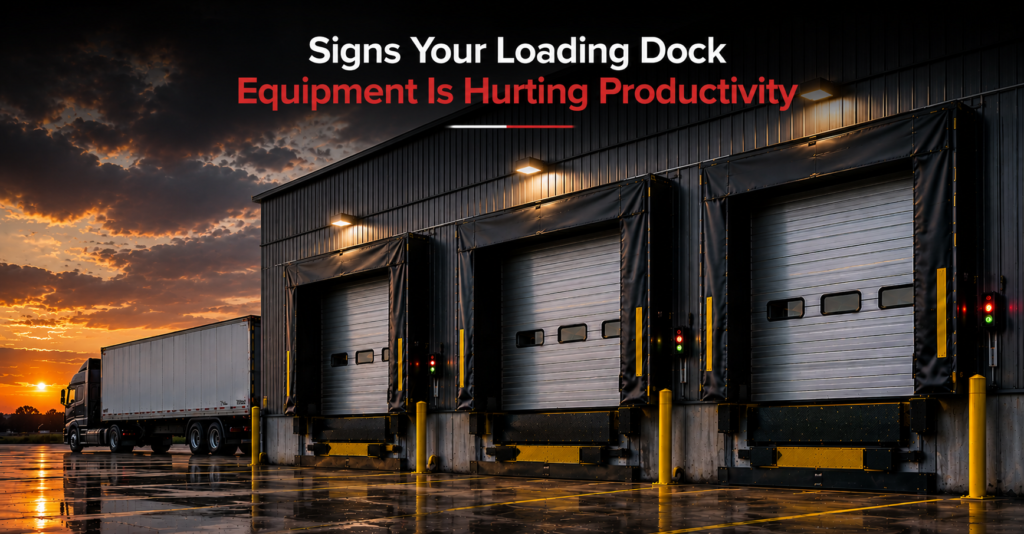
Most warehouses don’t lose productivity all at once. It happens gradually — a trailer that waits a few extra minutes here, a leveler that sticks a little more than it used to, a workaround that staff quietly adopt because it’s easier than reporting the same issue again. None of it looks urgent on any single day. Over weeks and months, though, these small frictions add up to a loading dock that’s working against your team instead of for them.
The tricky part is that many of these signs get normalized. Employees adjust their habits around a slow leveler or an unreliable restraint system without ever flagging it, because it’s just “how the dock works.” At VP Commercial Garage Doors, we regularly walk into facilities where staff describe a problem as routine, only for an inspection to reveal equipment that’s been quietly dragging down efficiency for a long time.
Here are the signs worth paying attention to — and what they usually mean.
Why Dock Equipment Problems Are Easy to Overlook
Loading docks run on routine. Staff develop habits around whatever equipment they’re given, even if that equipment isn’t performing the way it should. A leveler that takes an extra moment to engage, a seal that lets in a draft, a signal light that’s been out for weeks — these become part of the daily rhythm rather than red flags.
That’s exactly why it helps to step back periodically and look at the dock with fresh eyes. The signs below are the ones that tend to hide in plain sight.
Sign #1: Trailers Are Waiting Longer Than They Should
If trucks are regularly idling longer than expected before they can dock, or drivers are waiting after loading is complete before they can pull away, something in the process is creating friction. Sometimes it’s equipment. Sometimes it’s scheduling. Either way, consistent delays are rarely a coincidence — they’re usually a pattern worth investigating.
Sign #2: The Dock Leveler Is Slow, Sticking, or Drifting Under Load
A dock leveler that hesitates, jams, or shifts position while a forklift is on it isn’t just inconvenient — it’s one of the clearest warning signs that the equipment is nearing the end of reliable service. Position drift under load in particular should never be treated as a normal quirk. It’s often an early indicator of a mechanical issue that will only get worse with continued use.
Sign #3: You’re Calling for the Same Repair Again and Again
If a technician has been out for the same leveler, seal, or restraint issue more than once in a short period, the underlying problem likely hasn’t been fully resolved. Recurring repairs on the same component are a strong sign that the equipment needs a deeper evaluation rather than another quick fix.
Sign #4: Visible Rust, Corrosion, or Wear on Equipment
Reddish-brown patches on a dock leveler frame, hinges, or springs, or paint that’s bubbling and flaking, point to corrosion that’s already affecting the metal underneath. This kind of wear doesn’t stay cosmetic for long — it typically leads to weakened components and less reliable operation over time.
Sign #5: Drafts, Temperature Swings, or Rising Energy Use
Worn or damaged dock seals and shelters let outside air into the building every time a trailer is docked. If staff near the dock are noticing stronger drafts, or temperature-sensitive product stored nearby seems to be affected, the seals have likely degraded past the point of doing their job.
Sign #6: Staging Areas Are Constantly Overflowing
Slow, inconsistent loading and unloading doesn’t just affect the dock itself — it backs up into the staging area. If pallets are regularly piling up faster than they can be moved, the bottleneck often traces back to how efficiently the dock equipment is functioning, not just staffing levels.
Sign #7: Vehicle Restraints Feel Unreliable or Inconsistent
A restraint system that doesn’t engage smoothly, or that staff have learned to “double-check” out of habit, is a serious productivity and safety concern. Hesitation around trusting the equipment slows down every single loading cycle, even when nothing visibly goes wrong.
Sign #8: Staff Are Relying on Shouting or Hand Signals
If drivers and dock workers are coordinating departures and arrivals informally instead of through a signal or communication system, delays and miscommunication are almost guaranteed. This is often a sign that communication equipment is missing, outdated, or simply not being used consistently.
Sign #9: No One Has Real Visibility Into Dock Status
If finding out which bays are occupied or how long a trailer has been waiting requires physically walking the dock, there’s no efficient way to identify bottlenecks as they happen. This lack of visibility makes it difficult to catch productivity issues early, since problems only become obvious once they’ve already caused a delay.
Sign #10: Near-Misses or Safety Concerns Keep Coming Up
Safety and productivity are closely connected at a loading dock. If the same near-miss or safety concern keeps getting mentioned — a trailer that shifted unexpectedly, a forklift operator who had to stop short — it’s rarely an isolated event. It’s usually a sign that equipment isn’t performing the way it’s supposed to.
Sign #11: A Bay Has Gone Out of Service More Than Once
When a bay has to be taken offline for repairs, even briefly, it reduces overall dock capacity for everyone. If this has happened more than once for the same piece of equipment, it’s often the final warning sign before a more serious failure takes that bay out of commission for longer.
Why These Signs Matter Together, Not Just Individually
Any one of these signs on its own might seem manageable. But loading docks operate as a connected system — a slow leveler affects staging, a damaged seal affects comfort and product protection, a missing signal system affects communication and safety. When several of these signs show up at once, it’s usually a sign that the dock, as a whole, is overdue for a closer look.
What to Do When You Notice These Signs
- Walk the dock with fresh eyes, ideally with someone who isn’t used to the daily routine
- Ask staff directly what workarounds they’ve adopted, even if they haven’t flagged them as problems
- Track how long trailers typically wait, rather than relying on impressions
- Have equipment professionally inspected rather than assuming a quick fix will hold
- Prioritize the equipment tied to the most frequent delays or safety concerns first
- Reassess after any fix to confirm the underlying issue is actually resolved, not just masked
Why Working With a Commercial Specialist Matters
Recognizing these signs is only half the equation — knowing what’s actually causing them takes an experienced eye. VP Commercial Garage Doors works with warehouses and distribution centers to evaluate dock equipment as a full system, identifying not just the obvious issue but the underlying cause, so the fix actually holds.
Where We Help Businesses Diagnose Dock Productivity Issues
We work with facilities throughout the Chicagoland area, including Aurora, Wheaton, Northbrook, and Palatine, along with many surrounding communities. Wherever your facility is located, our team can help you identify exactly what’s slowing your dock down and what to prioritize first.
FAQs About Loading Dock Productivity Issues
How do I know if a dock problem is equipment-related or a scheduling issue?
Tracking wait times and comparing them across different shifts or trailer types can help separate equipment-related delays from scheduling patterns. A professional assessment can clarify this further.
Is it normal for staff to develop workarounds for dock equipment?
It’s common, but it’s usually a sign that an underlying issue hasn’t been addressed. Workarounds tend to mask problems rather than solve them.
Can one piece of faulty equipment really affect the whole dock’s productivity?
Yes. Dock equipment works as a connected system, so an issue with one component, like a leveler or restraint, often creates ripple effects across loading, staging, and scheduling.
How often should dock equipment be inspected to catch these signs early?
Routine inspections should happen on a regular schedule, with additional checks anytime recurring issues or near-misses are reported.
What’s the most overlooked sign of a productivity problem at the dock?
Position drift or hesitation in a dock leveler under load is one of the most commonly overlooked signs, since staff often treat it as a normal quirk rather than an early warning.
Contact VP Commercial Garage Doors
If your business needs dependable Commercial Garage Door Repair, Commercial Overhead Door Installation, Commercial Garage Door Maintenance, Rolling Steel Door Repair, High-Speed Commercial Doors, Dock Leveler Repair, Loading Dock Equipment Service, or Emergency Commercial Garage Door Repair, trust the experienced team at VP Commercial Garage Doors.
We proudly serve businesses throughout Elk Grove Village, Schaumburg, Naperville, Aurora, Buffalo Grove, Addison, Franklin Park, Palatine, Wheeling, Oak Brook, and surrounding Illinois communities.
Phone: 847 380 6448
Website: https://vpcommercialgaragedoors.com/
Call VP Commercial Garage Doors today to schedule professional commercial garage door service and keep your warehouse or industrial facility operating safely, efficiently, and without costly interruptions.
Final Thoughts
A loading dock rarely announces that it’s hurting productivity in an obvious way. It shows up in small delays, quiet workarounds, and issues that staff have simply learned to live with. Paying attention to these signs — and addressing them before they compound — is one of the most effective ways to keep a warehouse running the way it’s supposed to.
If any of these signs sound familiar, it’s worth having your dock equipment evaluated before the next delay turns into a bigger disruption.
Summary
Signs that loading dock equipment is hurting productivity include slow or drifting dock levelers, recurring repairs, visible rust or wear, drafts from worn seals, overflowing staging areas, unreliable vehicle restraints, and poor communication between drivers and staff. Addressing these signs early prevents bigger disruptions and safety risks.