

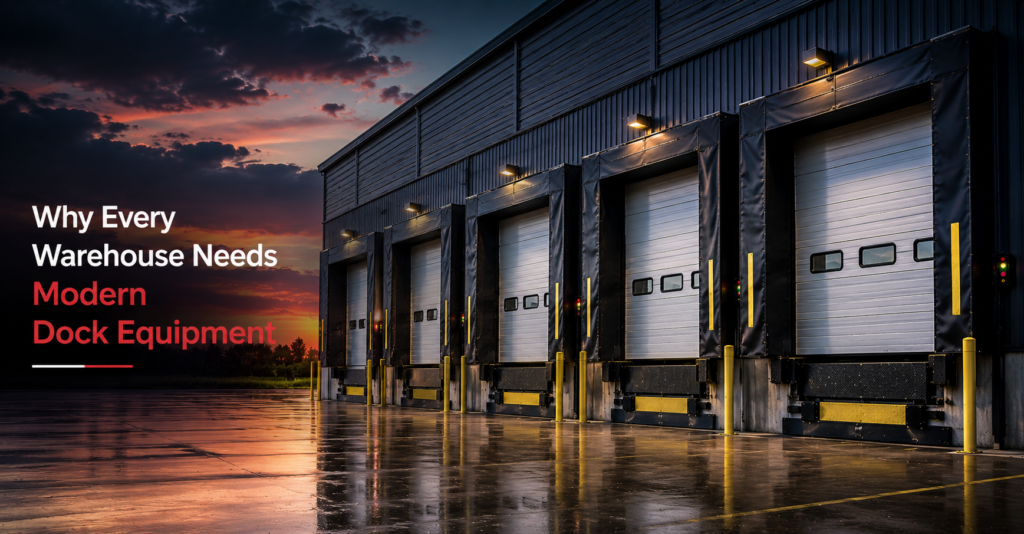
Walk into almost any warehouse built decades ago, and you’ll likely find the same loading dock setup it started with — a manual leveler, basic seals, maybe a single light to signal when a truck is clear. It still works, technically. But “still works” and “works well” are two very different standards, especially in a facility where the loading dock touches nearly every shipment that comes in or out.
Modern dock equipment isn’t about chasing the newest technology for its own sake. It’s about closing the gap between how warehouses actually operate today — faster cycles, tighter safety expectations, more data-driven decisions — and equipment that was designed for a slower, less demanding pace. At VP Commercial Garage Doors, we see this gap firsthand in facilities that are otherwise well-run but still relying on dock equipment that hasn’t kept up with how the rest of the operation has evolved.
What Counts as “Modern” Dock Equipment
“Modern” doesn’t necessarily mean fully automated or robotic. It means equipment designed with today’s safety standards, energy expectations, and operational pace in mind. That typically includes:
- Electric or smart dock levelers instead of manual or purely mechanical ones
- Vehicle restraint systems rather than simple wheel chocks alone
- Motion-sensing safety technology that detects people or equipment near an open trailer
- Dock communication and signal systems that coordinate drivers and staff
- High-speed doors built for frequent cycling
- Dock management software that gives visibility into real-time dock status
None of these require a complete facility overhaul. Most warehouses upgrade gradually, replacing outdated components as they identify the biggest gaps.
Why Outdated Dock Equipment Holds a Warehouse Back
Loading docks are some of the busiest, highest-risk areas in any facility, with trucks, forklifts, and workers all moving through the same tight space. Industry safety research consistently shows that shipping and receiving areas account for a disproportionate share of industrial accidents compared to other parts of a warehouse — and much of that risk comes down to outdated or poorly maintained equipment.
Beyond safety, older dock equipment tends to create hidden inefficiencies. A manual leveler takes longer to operate than an electric one. A dock without proper seals loses conditioned air every time a trailer is parked. A facility without real-time dock visibility has no way to know which bays are sitting idle or which ones are creating bottlenecks. Individually, these issues might seem minor. Together, they slow down the entire operation in ways that are easy to overlook until they’re measured.
The Core Benefits of Modern Dock Equipment
Improved Worker Safety
Modern safety technology, like motion-sensing systems and reliable vehicle restraints, directly reduces the risk of the most serious loading dock incidents — including trailer separation and struck-by accidents involving forklifts or pedestrians.
Faster Truck Turnaround
Electric levelers, high-speed doors, and clear communication systems all reduce the time it takes to dock, load, and release a trailer. Faster turnaround means more throughput without adding staff or expanding the physical footprint.
Better Energy Efficiency
Dock seals, shelters, and well-sealed doors prevent conditioned air from escaping every time a trailer is docked. This matters year-round, especially in a climate like Illinois, where facilities deal with both cold winters and humid summers.
Real-Time Visibility and Data
Modern dock management systems give facility managers a live view of which bays are occupied, which trailers are waiting, and where delays are happening. That visibility makes it possible to fix bottlenecks based on actual data instead of guesswork.
Reduced Equipment Downtime
Older mechanical systems tend to fail more unpredictably and are often harder to service, since replacement parts for outdated models can be difficult to source. Modern equipment is generally easier to maintain and diagnose, which keeps bays in service more consistently.
Key Types of Modern Dock Equipment Worth Investing In
Electric and Smart Dock Levelers
Electric levelers operate more smoothly and consistently than manual or hydraulic systems, with fewer moving parts prone to failure. They also tend to require less maintenance over time, since they eliminate the pressurized fluid systems that hydraulic levelers depend on.
Vehicle Restraint Systems
A proper restraint system locks a trailer in place for the duration of loading and unloading, addressing one of the most serious risks at any dock: a trailer pulling away while workers or equipment are still inside.
Dock Seals and Shelters
These create a tight barrier between the trailer and the building, protecting both the internal climate and the goods being loaded or unloaded from outside weather conditions.
Communication and Signal Systems
Coordinated light systems tell drivers exactly when it’s safe to approach or leave a dock, reducing the miscommunication that leads to premature departures and unnecessary delays.
Motion-Sensing Safety Technology
Sensors that detect a person or piece of equipment near an open trailer add a layer of protection that manual protocols alone can’t guarantee, especially in high-traffic environments.
High-Speed Dock Doors
A door that cycles quickly reduces the time a bay sits open, which improves both energy efficiency and overall dock throughput, especially in facilities with frequent trailer turnover.
Signs Your Warehouse Is Overdue for an Upgrade
- Dock equipment requires frequent repairs or hard-to-find replacement parts
- Trailers regularly wait longer than they should to dock or depart
- Staff rely on shouting or hand signals instead of a communication system
- There’s no way to see which bays are occupied without physically checking
- Energy costs seem high relative to the size and use of the facility
- Near-misses or safety concerns have come up more than once in the same area
If more than one of these sounds familiar, it’s worth having a professional assessment done before deciding what to prioritize.
Common Mistakes When Upgrading Dock Equipment
Replacing equipment without addressing the underlying workflow. New equipment installed into the same inefficient layout often produces smaller improvements than expected.
Choosing equipment that doesn’t match actual trailer traffic. A leveler or restraint system sized for the wrong trailer type creates ongoing problems instead of solving them.
Upgrading one component while ignoring related systems. A high-speed door paired with an outdated leveler or missing seals still leaves major gaps in efficiency and protection.
Treating the upgrade as a one-time project. Even modern equipment needs regular maintenance to keep performing the way it was designed to.
How to Prioritize Upgrades Without Overhauling Everything at Once
Most warehouses don’t need to replace every piece of dock equipment at once. A practical approach starts with identifying the biggest safety risk first, followed by the equipment causing the most frequent delays or downtime. From there, upgrades can be phased in gradually, guided by which bays see the heaviest use and which issues come up most often during daily operations.
Why Working With a Commercial Specialist Matters
Modernizing dock equipment isn’t just about buying newer parts — it’s about making sure everything is installed correctly, calibrated properly, and maintained on a schedule that keeps it reliable. At VP Commercial Garage Doors, our technicians help facilities evaluate their current dock setup and identify where an upgrade will make the biggest difference, rather than recommending changes that don’t match how the warehouse actually operates.
Where We Help Warehouses Modernize Their Dock Equipment
We work with facilities throughout the Chicagoland area, including Glenview, Mount Prospect, Elmhurst, and Bolingbrook, along with many surrounding communities. Wherever your warehouse is located, our team can assess your current dock equipment and help you plan upgrades that improve safety and efficiency without unnecessary disruption to daily operations.
FAQs About Modern Warehouse Dock Equipment
Is it necessary to replace all dock equipment at once when modernizing?
No. Most warehouses upgrade gradually, starting with the equipment causing the biggest safety or efficiency gaps.
What’s the biggest safety improvement modern dock equipment offers?
Reliable vehicle restraint systems and motion-sensing technology directly address two of the most serious risks at any loading dock: trailer separation and struck-by incidents.
Does upgrading dock equipment really improve energy efficiency?
Yes. Properly sealed doors and dock shelters significantly reduce the amount of conditioned air lost every time a trailer is docked.
How do I know which piece of equipment to upgrade first?
Start with whatever creates the most frequent delays or safety concerns. A professional assessment can help identify the highest-impact upgrade for your specific operation.
Can older dock equipment be maintained instead of replaced?
Sometimes, especially if it’s still structurally sound. But equipment with hard-to-find parts or a long history of repeated failures is usually a stronger candidate for replacement.
Contact VP Commercial Garage Doors
If your business needs dependable Commercial Garage Door Repair, Commercial Overhead Door Installation, Commercial Garage Door Maintenance, Rolling Steel Door Repair, High-Speed Commercial Doors, Dock Leveler Repair, Loading Dock Equipment Service, or Emergency Commercial Garage Door Repair, trust the experienced team at VP Commercial Garage Doors.
We proudly serve businesses throughout Elk Grove Village, Schaumburg, Naperville, Aurora, Buffalo Grove, Addison, Franklin Park, Palatine, Wheeling, Oak Brook, and surrounding Illinois communities.
Phone: 847 380 6448
Website: https://vpcommercialgaragedoors.com/
Call VP Commercial Garage Doors today to schedule professional commercial garage door service and keep your warehouse or industrial facility operating safely, efficiently, and without costly interruptions.
Final Thoughts
A warehouse can be well-run in every other respect and still lose time, safety margin, and efficiency at the loading dock simply because the equipment hasn’t kept pace with how the rest of the operation runs. Modernizing dock equipment isn’t about chasing every new technology — it’s about closing the specific gaps that are slowing your facility down or putting your team at risk.
If it’s been a while since your dock equipment was evaluated, that’s usually the clearest sign it’s time to take a closer look.
Summary
Modern dock equipment — including electric levelers, vehicle restraints, motion-sensing safety technology, and dock seals — improves warehouse safety, speeds up truck turnaround, reduces energy loss, and lowers equipment downtime compared to outdated manual systems. Upgrading key components helps warehouses operate more efficiently and safely.