

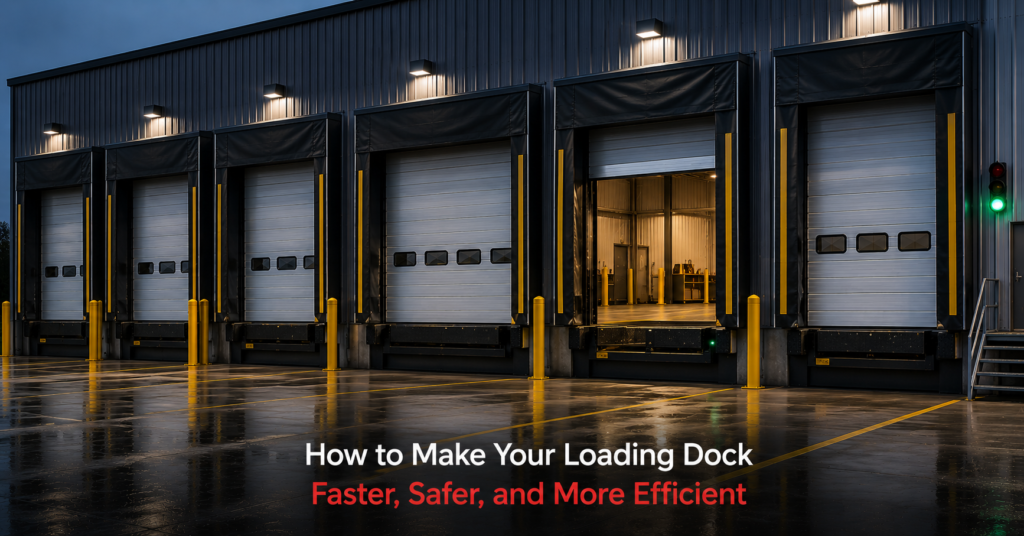
The loading dock is one of the busiest, most overlooked parts of any commercial facility. Trucks come and go, forklifts move constantly, and dozens of small decisions — how a trailer is secured, how well the dock is lit, how smoothly the door opens — add up to either a smooth operation or a bottleneck. At VP Commercial Garage Doors, we work with facilities across Illinois to keep loading dock equipment running the way it should, and we’ve seen firsthand how a few targeted improvements can transform a dock from a daily headache into one of the most efficient parts of the building.
If your loading dock feels slower or less predictable than it should be, the good news is that most of the fixes don’t require a complete overhaul. They come down to equipment, layout, communication, and maintenance habits working together.
Why the Loading Dock Deserves More Attention
Loading docks are high-traffic, high-risk areas by nature. Trucks are backing in, forklifts are moving loads, and people are working in close proximity to both. Industry safety data consistently shows that loading docks account for a disproportionate share of injuries in supply chain and warehouse facilities compared to other areas of a building.
That combination of heavy activity and real risk is exactly why the loading dock deserves more attention than it typically gets. Improvements here don’t just speed up operations — they directly reduce the chances of an accident.
Start With the Right Equipment
Efficiency and safety both start with having the right equipment in place, properly maintained and suited to how your dock actually operates.
Dock Levelers That Match Your Trailer Traffic
A dock leveler bridges the gap between the trailer and the dock floor, and it needs to match the height and weight range of the trailers using it regularly. A leveler that’s undersized or poorly maintained becomes a bottleneck — and a safety hazard — every time it’s used. Regular inspection of the leveler’s springs, hinges, and lip is essential, since this component handles constant mechanical stress throughout the day.
Dock Seals and Shelters
A significant amount of energy is lost through the gaps around a trailer parked at an open dock door. Dock seals and shelters close that gap, which helps regulate indoor temperature, reduce drafts, and protect goods that are sensitive to temperature swings. This matters year-round in Illinois, where facilities deal with both harsh winters and humid summers.
Vehicle Restraints and Wheel Chocks
Trailer separation — when a trailer shifts or pulls away from the dock while it’s still being loaded — is one of the most serious risks at any loading dock. Vehicle restraints and wheel chocks keep the trailer securely in place throughout the loading process, and they should be checked regularly to confirm they’re functioning correctly.
Dock Bumpers and Guides
Bumpers protect both the building and the trailer from impact damage during docking, while wheel guides help drivers line up quickly and accurately. Worn or missing bumpers lead to more building damage over time and slower, more hesitant docking as drivers try to avoid contact.
High-Speed and High-Performance Doors
The door itself plays a bigger role in efficiency than most people realize. A high-speed commercial door opens and closes significantly faster than a standard overhead door, which reduces the time a bay sits open, limits temperature loss, and keeps traffic moving. For facilities with high dock turnover, upgrading to a faster door is one of the more impactful changes available.
Improve Traffic Flow and Communication
Even with great equipment, a loading dock can still run inefficiently if drivers, forklift operators, and dock workers aren’t communicating clearly.
Dock Communication Lights
Red and green signal lights outside each dock door tell drivers exactly when it’s safe to approach or pull away. This simple system prevents premature departures — one of the leading causes of trailer separation incidents — while keeping the docking process moving without constant back-and-forth communication.
Separating Pedestrian and Forklift Traffic
Clearly marked walkways and designated forklift paths reduce the chance of a collision and keep both people and equipment moving predictably. This is a simple layout change that pays off every single day the dock is in use.
Appointment Scheduling and Dock Management Tools
Congestion often isn’t about how fast any single task happens — it’s about too many trucks arriving at once with no coordination. Scheduling software or even a basic appointment system helps stagger arrivals, reduce wait times, and give dock staff better visibility into what’s coming next.
Build Safety Into Daily Operations
Efficiency and safety aren’t separate goals at a loading dock — they reinforce each other. A safer dock is almost always a faster one, because fewer near-misses and incidents mean fewer interruptions.
Keep Aisles and Staging Areas Clear
Cluttered staging areas slow down every task that happens near them. Keeping aisles clean, organized, and free of obstructions isn’t just good practice — it directly affects how quickly product can move through the space.
Proper Lighting and Signage
Loading docks often deal with limited natural light and constant activity, which makes proper lighting essential for both speed and safety. Clear signage reinforces safe behavior without requiring constant supervision.
Ongoing Staff Training
Equipment and layout can only go so far without trained people operating within the system correctly. Regular refresher training on safety procedures and proper equipment use keeps habits sharp, especially as new staff join the team.
Don’t Overlook Preventive Maintenance
A loading dock is only as efficient as its least reliable piece of equipment. A dock leveler that sticks, a door that’s slow to open, or a restraint system that isn’t functioning properly doesn’t just create a safety risk — it slows down every single load that passes through that bay.
Routine inspection of dock doors, levelers, seals, and restraints catches small issues before they turn into an out-of-service bay. This is one of the simplest ways to protect both efficiency and safety at the same time, and it pairs naturally with a broader commercial garage door maintenance routine for the rest of the facility.
Common Loading Dock Mistakes That Slow Things Down
Treating the dock door like an afterthought. The door is one of the most frequently used pieces of equipment on the entire dock, and a slow or unreliable one creates a bottleneck at every single cycle.
Skipping regular equipment inspections. Waiting for something to visibly fail means the dock has likely already been operating less efficiently for a while.
Allowing staging areas to become cluttered. A disorganized dock area slows down every task connected to it, even ones that have nothing to do with the clutter itself.
Underestimating communication gaps. Without clear signals between drivers and dock staff, even a well-equipped dock can experience delays and near-misses.
Ignoring seasonal wear. Illinois winters are hard on seals, springs, and hardware. Skipping a seasonal check often means dealing with a bigger issue right when the dock is busiest.
A Quick Efficiency and Safety Checklist
- Confirm dock levelers are properly rated for your typical trailer traffic
- Inspect seals, shelters, and weatherstripping for wear
- Test vehicle restraints and wheel chocks regularly
- Replace worn bumpers and guides before damage becomes more serious
- Install or maintain dock communication lights
- Keep pedestrian and forklift paths clearly separated
- Maintain clean, organized staging areas
- Schedule routine maintenance for doors, levelers, and hardware
- Provide ongoing safety training for dock staff
Why the Right Equipment Partner Matters
A faster, safer loading dock depends on equipment that’s properly installed, well-maintained, and suited to how your facility actually operates. VP Commercial Garage Doors works with businesses to keep dock doors, hardware, and related equipment functioning reliably, so bottlenecks and safety risks get addressed before they slow down your operation.
Where We Help Businesses Improve Their Loading Docks
We work with facilities throughout the Chicagoland area, including Skokie, Des Plaines, Buffalo Grove, and Hoffman Estates, along with many surrounding communities. Wherever your facility is located, our team can assess your current dock setup and help identify the changes that will make the biggest difference.
FAQs About Loading Dock Efficiency and Safety
What’s the single biggest factor in loading dock efficiency?
Reliable, well-maintained equipment — especially the dock door and leveler — since these are used constantly and any slowdown there affects every load that passes through.
How often should loading dock equipment be inspected?
Routine inspections should happen regularly, with more frequent checks for high-traffic docks and an additional seasonal check ahead of extreme weather.
Can better communication really improve dock speed?
Yes. Miscommunication between drivers and dock staff is a common cause of delays and safety incidents, and simple tools like signal lights address this directly.
Do dock seals actually make a noticeable difference?
Yes. They reduce drafts and temperature loss around the trailer opening, which matters for both energy efficiency and product protection.
Is upgrading to a high-speed door worth it for every facility?
It depends on dock traffic. Facilities with frequent trailer turnover typically see the most benefit from faster-cycling doors, while lower-traffic docks may not need the upgrade as urgently.
Contact VP Commercial Garage Doors
If your business needs dependable Commercial Garage Door Repair, Commercial Overhead Door Installation, Commercial Garage Door Maintenance, Rolling Steel Door Repair, High-Speed Commercial Doors, Dock Leveler Repair, Loading Dock Equipment Service, or Emergency Commercial Garage Door Repair, trust the experienced team at VP Commercial Garage Doors.
We proudly serve businesses throughout Elk Grove Village, Schaumburg, Naperville, Aurora, Buffalo Grove, Addison, Franklin Park, Palatine, Wheeling, Oak Brook, and surrounding Illinois communities.
Phone: 847 380 6448
Website: https://vpcommercialgaragedoors.com/
Call VP Commercial Garage Doors today to schedule professional commercial garage door service and keep your warehouse or industrial facility operating safely, efficiently, and without costly interruptions.
Final Thoughts
A faster, safer loading dock isn’t the result of one big change — it’s the result of equipment, layout, and habits all working together. From the dock leveler to the door itself, every component plays a role in how smoothly trucks move in and out of your facility.
If your loading dock has been feeling slower or less predictable than it should, a professional assessment is the easiest way to find out exactly where the friction is coming from — and what to fix first.
Summary
Making a loading dock faster, safer, and more efficient involves upgrading key equipment like dock levelers, seals, restraints, and high-speed doors, improving traffic flow with communication tools, keeping staging areas organized, and maintaining a consistent equipment inspection schedule to prevent slowdowns and accidents.