

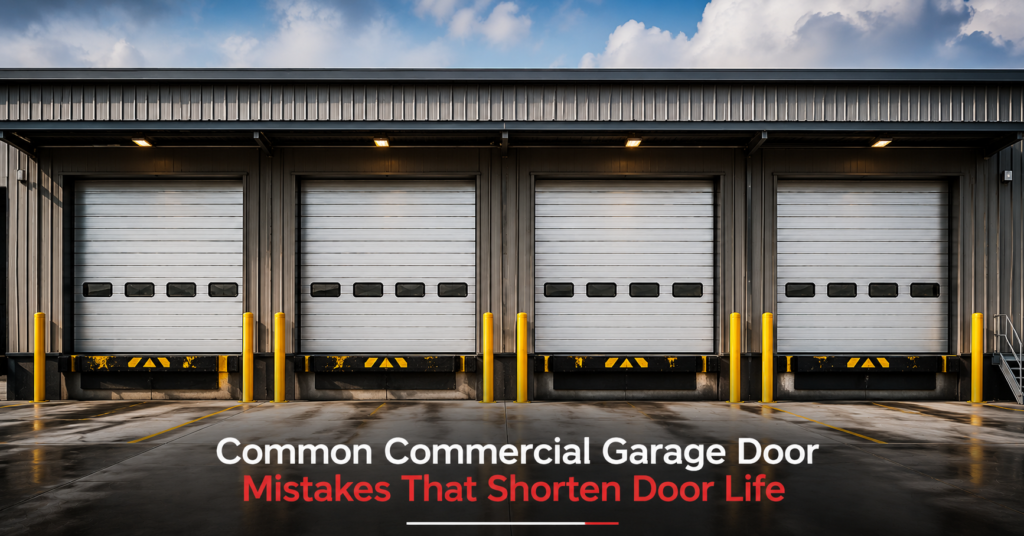
A commercial garage door is built to take a beating. It’s designed for constant use, heavier loads, and a lot more wear than the door on a typical home. But “built tough” doesn’t mean “immune to bad habits.”
Most premature door failures aren’t caused by faulty equipment. They’re caused by small, everyday mistakes that quietly stack up until a spring snaps, an opener burns out, or a track bends beyond repair. The frustrating part is that almost all of these mistakes are preventable — most facility teams just don’t realize they’re doing them.
This guide walks through the most common ways commercial garage doors get shortchanged on lifespan, and what to do instead to keep the system running the way it was designed to.
Why Commercial Doors Wear Out Faster Than People Expect
A residential garage door cycles open and closed a modest number of times over the course of a year. A commercial door at a warehouse, distribution center, or loading dock can rack up that same amount of use in a matter of weeks. Every open-and-close cycle puts stress on the springs, cables, rollers, and opener — so mistakes that seem minor on a home garage door get amplified fast on a commercial system.
Springs and hardware are rated for a finite number of cycles before they naturally wear out. A door that’s misused or neglected can burn through that rating well ahead of schedule. That’s the core reason small habits matter so much here — the margin for error is a lot smaller than most facility managers assume.
Mistake #1: Leaving the Door Partially Open
This is one of the most common — and most damaging — habits in commercial settings. Employees leave the door halfway up for ventilation, quick access, or convenience between deliveries.
The problem is that most commercial door openers are engineered to hold the door securely in the fully open or fully closed position, not indefinitely suspended halfway. Holding a door at a mid-point puts ongoing strain on the opener motor and drive system. Over time, this accelerates motor wear and can lead to a door that suddenly drops.
It’s also a safety hazard. A partially open door can fail without warning, creating a real risk for anyone walking underneath it. The fix is simple: keep the door fully open or fully closed, and use proper ventilation or pedestrian doors instead.
Mistake #2: Ignoring Door Balance
A balanced door moves smoothly on its own with the opener disconnected. An unbalanced one puts uneven tension on the springs, forces the opener to work harder, and creates friction points along the track.
Balance problems rarely announce themselves loudly. They show up as a door that feels heavier on one side, closes unevenly, or makes the opener strain more than usual. Left unaddressed, an unbalanced door leads to premature spring fatigue, roller wear, and eventually opener failure.
A simple check: disconnect the opener and manually lift the door halfway. If it doesn’t stay in place or moves unevenly, it’s out of balance and due for a professional adjustment.
Mistake #3: Skipping Lubrication — or Using the Wrong Product
Rollers, hinges, springs, and the torsion bar all rely on proper lubrication to move smoothly. Without it, metal-on-metal contact increases friction, noise, and wear with every cycle.
The WD-40 Problem
Here’s a mistake that even well-intentioned facility teams make: reaching for WD-40. It’s a solvent and water displacer, not a lubricant. Applied to springs and rollers, it actually strips away the grease those parts need, leaving them drier and more prone to wear than before.
The right choice is a silicone-based or lithium-based lubricant designed specifically for garage door hardware. A quick, regular lubrication pass is a low-effort habit that meaningfully extends component life.
Mistake #4: Ignoring Early Warning Signs
A door that starts grinding, squeaking, or vibrating differently than usual is communicating something. Worn rollers sound different from fresh ones. A spring under uneven tension produces a distinct noise. A track that’s shifted out of alignment causes a jerking motion instead of a smooth glide.
Facilities that respond to these changes early catch problems while they’re still minor and simple to fix. Facilities that wait until the door stops working entirely turn a routine adjustment into an emergency repair — often on the worst possible day.
Mistake #5: Leaving Hardware Loose
Constant vibration from daily cycling gradually loosens bolts, brackets, and screws. It’s an easy thing to overlook because it doesn’t affect how the door operates — until it does.
Loose hardware leads to uneven wear, rattling operation, and in some cases, parts detaching entirely. A quick hardware check during routine maintenance — tightening anything that’s worked loose — prevents a lot of downstream damage.
Mistake #6: Installing Residential-Grade or Mismatched Parts
Not every repair is equal. Lower-grade rollers, lightweight hinges, or springs that aren’t properly matched to the door’s weight can shorten the system’s life even if the door seems to work fine right after the fix.
The door may operate, but not efficiently. That often shows up later as repeated noise, faster wear, or an opener straining harder than it should. A commercial garage door is a balanced system — when one component is underbuilt for the load, the surrounding parts absorb the extra stress. This is why working with a technician experienced in commercial garage door repair matters: the parts and specifications aren’t the same as residential hardware.
Mistake #7: Overlooking Track Alignment and Impact Damage
A door doesn’t need a dramatic accident to get knocked out of alignment. A bumper tap, a forklift graze, or a heavy object hitting the track can shift things just enough to matter.
These issues often look cosmetic at first — a small dent, a slightly shifted track — but they cause uneven travel, added vibration, and long-term wear because the door is no longer moving cleanly along its intended path. Any visible impact to the track or panels is worth a professional look, even if the door still seems to operate normally.
Mistake #8: Setting the Opener Force Too High
When an opener’s force setting is too high, it pushes and pulls the door with more power than the hardware is built to absorb. Over time, that excess force stresses the hinges, can bend the top section of the door, and wears out the spring system faster than normal use would.
This setting is often adjusted (or misadjusted) during a repair or installation and then forgotten. It’s worth having a technician verify the force setting is correctly calibrated to the door’s actual weight, not just “strong enough to close reliably.”
Mistake #9: Fixing Only the Visible Symptom
A failed opener or a sticking door is usually an indicator, not the root problem. Commercial door systems rely on multiple connected parts working together — springs, cables, tracks, rollers, and the opener all affect one another.
Repairing the obvious issue without checking the surrounding system often leads to repeat failures. A proper inspection checks balance, tension, alignment, and hardware condition before any repair begins, which prevents the same problem from resurfacing down the road.
Mistake #10: Skipping Professional Inspections
Many facility teams assume a door is fine as long as it’s opening and closing. But by the time a problem is visible or audible, the underlying wear has usually been building for a while.
Why DIY Repairs Are Riskier on Commercial Doors
Commercial doors are large, heavy systems under significant spring tension, and they require specialized tools and training to service safely. Attempting repairs without the right experience isn’t just a lifespan risk — it’s a safety risk. Professional technicians know how to safely adjust springs, inspect structural components, and calibrate opener systems in a way that protects both the equipment and the people working around it.
Mistake #11: Neglecting the Safety Reversal System
The auto-reverse feature is designed to stop and reverse the door if it senses an obstruction while closing — a requirement under UL safety standards for commercial door systems. If this feature isn’t tested regularly, it can fail silently.
A simple test: place a solid object, like a block of wood, in the door’s path while it’s closing. If the door doesn’t reverse immediately upon contact, it needs professional attention right away. This isn’t just a maintenance issue — it’s a liability and workplace safety issue.
Mistake #12: Ignoring Seasonal and Weather Stress
Illinois weather is a real factor in commercial door lifespan. Cold winters make springs more brittle and more likely to snap during operation, especially if they haven’t been lubricated before the temperature drops. Freeze-thaw cycles also affect seals, rollers, and weatherstripping, while humid summers can accelerate wear on rubber components.
Scheduling a maintenance check ahead of the harshest part of winter — and again heading into summer — helps components handle seasonal stress instead of absorbing it unprepared.
Mistake #13: Waiting Until It Becomes an Emergency
This might be the biggest mistake of all, because it’s really the sum of every mistake above. Doors that receive proactive attention typically last considerably longer than doors that only get attention once they’ve already failed. A well-maintained commercial door can serve a facility reliably for a long time. A neglected one often needs major repair or full replacement much sooner than it should.
How to Build Better Habits: A Quick Checklist
- Keep the door fully open or fully closed — never parked halfway
- Check door balance periodically, or have a technician verify it
- Lubricate rollers, hinges, and springs with the correct product on a regular basis
- Address new noises or vibration right away, not “when there’s time”
- Tighten loose hardware during routine checks
- Use commercial-grade parts matched to the door’s actual weight and usage level
- Inspect tracks and panels after any visible impact
- Test the auto-reverse safety feature regularly
- Schedule seasonal inspections ahead of winter and summer
- Book routine professional maintenance instead of waiting for a breakdown
Why Working With a Commercial Specialist Matters
Avoiding these mistakes starts with having the right team behind your door. At VP Commercial Garage Doors, our technicians work exclusively with commercial-grade systems, so every inspection accounts for balance, hardware condition, opener calibration, and safety compliance — not just the part that’s obviously broken. Whether your facility needs a routine maintenance visit or a full evaluation after noticing new noise or resistance, catching these issues early is what protects your investment over the long run.
Areas We Serve
VP Commercial Garage Doors provides commercial garage door repair and maintenance services throughout the Chicagoland area, including Naperville, Aurora, Schaumburg, Arlington Heights, Elgin, Skokie, Elmhurst, Des Plaines, Buffalo Grove, Hoffman Estates, Glenview, and Mount Prospect, along with surrounding communities such as Elk Grove Village, Wheaton, Bolingbrook, and Northbrook. Wherever your facility is located, our team can help you build a maintenance routine that keeps your door running well for years to come.
FAQs About Commercial Garage Door Lifespan and Common Mistakes
What’s the single most damaging habit for a commercial garage door?
Leaving the door parked in a partially open position is one of the most common and most damaging habits, since most openers aren’t designed to hold that position long-term.
How often should hardware be checked for looseness?
Hardware should be checked during every routine maintenance visit, and more frequently for high-traffic commercial doors.
Can a mismatched part really shorten a door’s lifespan, even if it works after the repair?
Yes. Parts that aren’t properly rated for the door’s weight and usage level put extra stress on surrounding components, leading to faster wear even if the immediate issue appears resolved.
Is it really necessary to test the auto-reverse safety feature regularly?
Yes. It’s a critical safety system, and it can fail without any obvious warning sign. Regular testing is the only reliable way to confirm it’s working.
How much longer can a well-maintained commercial door last compared to a neglected one?
A well-maintained door can last considerably longer than a neglected one, which often requires major repair or replacement well before its time.
Final Thoughts
Most commercial garage door failures don’t come out of nowhere. They’re the result of small habits — a door left half open, a skipped lubrication cycle, a noise that got ignored — that quietly add up over time. The good news is that every one of these mistakes is fixable, and most of them cost nothing more than a little attention.
If your commercial garage door has been showing any of these warning signs, don’t wait for it to turn into a full breakdown. A professional inspection now is the simplest way to protect the years of service your door has left.
Contact VP Commercial Garage Doors
If your business needs dependable Commercial Garage Door Repair, Commercial Overhead Door Installation, Commercial Garage Door Maintenance, Rolling Steel Door Repair, High-Speed Commercial Doors, Dock Leveler Repair, Loading Dock Equipment Service, or Emergency Commercial Garage Door Repair, trust the experienced team at VP Commercial Garage Doors.
We proudly serve businesses throughout Elk Grove Village, Schaumburg, Naperville, Aurora, Buffalo Grove, Addison, Franklin Park, Palatine, Wheeling, Oak Brook, and surrounding Illinois communities.
Phone: 847 380 6448
Website: https://vpcommercialgaragedoors.com/
Call VP Commercial Garage Doors today to schedule professional commercial garage door service and keep your warehouse or industrial facility operating safely, efficiently, and without costly interruptions.
Summary
Common mistakes that shorten commercial garage door life include leaving the door partially open, skipping lubrication or using the wrong product, ignoring balance issues, loose hardware, mismatched parts, and delaying professional inspections. Addressing these habits early helps commercial doors last significantly longer instead of failing prematurely.